

The boutique pedal world just got a lot more numerical. Teaching Machines has officially launched the FuzzBillion, a £435 analogue distortion device that replaces traditional knobs with eleven tactile thumbwheel switches, promising a near-infinite spectrum of grit.
In an era of digital modeling and menu-diving, the Teaching Machines FuzzBillion is a defiant return to tactile, analogue chaos. Priced at £435.00, this isn’t just another fuzz box; it’s a “distortion playground” designed for guitarists, bassists, and synth enthusiasts who find three-knob pedals limiting.
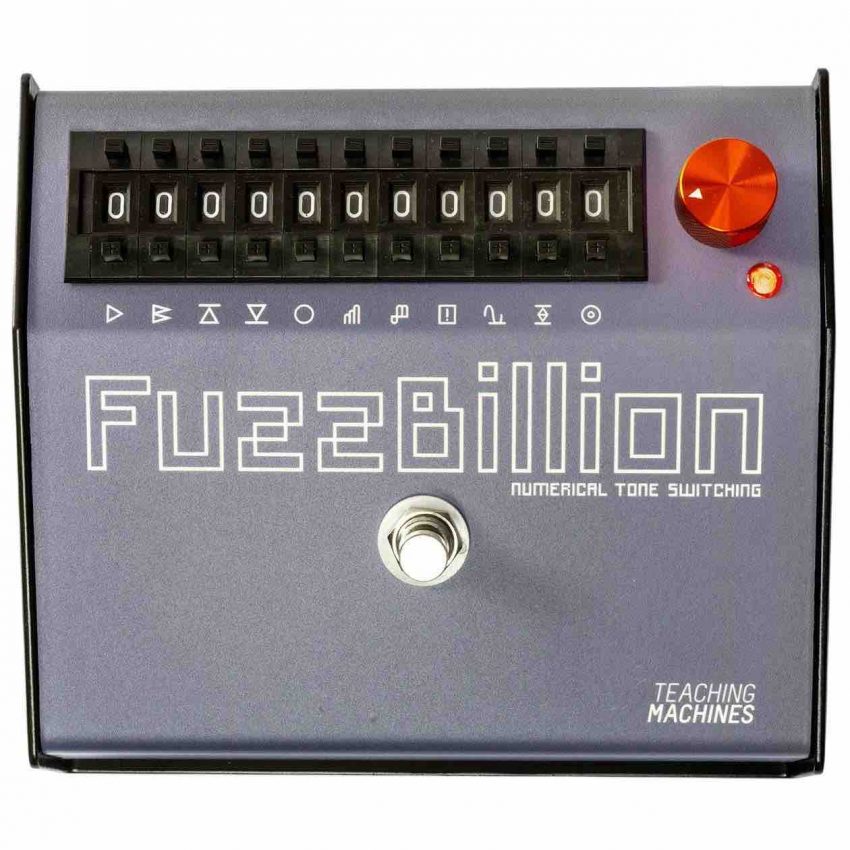
The standout feature is the interface: eleven “clicky” numerical plungers. Because each tone is assigned a specific digit, the FuzzBillion solves the age-old “lost setting” dilemma. If you find a world-shattering tone, you don’t need tape or markers—you just need to remember the 11-digit code.
A Zoo of Analogue Clipping
Under the hood, the FuzzBillion is “totally analogue and totally bonkers.” It utilizes a diverse array of clipping components, including Germanium, Silicon, and LEDs. The signal path flows strictly from left to right, meaning a slight adjustment on Wheel 1 fundamentally reshapes how the subsequent ten wheels behave.

The Eleven-Wheel Breakdown
The pedal’s architecture is divided into specialized “zones” of sonic destruction:
-
Gain & Fuzz (Wheel 1): Moves from clean op-amp boosts to gated transistor fuzz.
-
The Clipping Core (Wheels 2-4): Manages gain and asymmetrical waveform clipping (top and bottom).
-
Tone & Octave (Wheels 5-7): A deep EQ section followed by a screaming “octave-up” circuit that flips the waveform.
-
Experimental Glitch (Wheels 8-9): Features a Phase-Locked Loop (PLL) for robotic, tracking synth tones and a Bias Offset for “broken” splattery textures.
-
The Finish (Wheels 10-11): A final diode clipping stage for sustain and a master low-pass filter to tame the high-end “fizz.”

Studio-Ready Connectivity
Teaching Machines has ensured the FuzzBillion isn’t just for pedalboards. It features dedicated Input and Output Guitar/Line switches. This allows users to toggle between high-impedance guitar signals and low-impedance balanced line signals, making it a formidable tool for studio outboard processing on synths or drum machines.
FuzzBillion FAQ
How do I save my presets?
Since the pedal is 100% analogue, there are no digital presets. However, because every setting is a physical number (0-9), you can simply write down your “code” or take a photo of the wheels to recall the exact sound later.
Can I use this with my synthesizer?
Yes! Thanks to the side-mounted Line Level switches, the FuzzBillion can handle the hotter output of synths and studio gear without unwanted input clipping.
What is the PLL (Wheel 8) and why isn’t it making noise?
The Phase-Locked Loop is an oscillator that tries to “lock” onto your pitch. It requires a strong, high-gain signal to trigger. If you aren’t hearing it, try increasing the gain on the earlier wheels.
Is it true bypass?
The FuzzBillion is designed for tonal purity, and while it features a “bypass” setting on various wheels (like Wheel 5 or 11), the primary gain stages are designed to be part of an active signal chain.


The Verdict
| Pros | Cons |
| Infinite Variety: Billions of combinations for unique sound design. | Learning Curve: Not for those who want “plug-and-play” simplicity. |
| Recallable Settings: Numerical wheels make “presets” easy to document. | Price Point: At £435, it is a significant investment for a dirt pedal. |
| Studio Versatility: Line-level I/O is great for producers. | Footprint: The wide interface requires a fair amount of board real estate. |
Final Thoughts
The Teaching Machines FuzzBillion is a masterpiece for the sonic scientist. It’s expensive and unapologetically complex, but for those who want to move beyond “standard” distortion into the realm of glitch, synth-fuzz, and textured drive, there is simply nothing else like it on the market.
More Information
#Teaching Machines # FuzzBillion
This article may contain affiliate links to Andertons, DeathCloud,Donner, Fender, Gear4Music, Positive Grid, Stew Mac, Sweetwater, and Thomann that help finance the running costs of GuitarBomb. We will receive a small commission if you buy something through these links. Don’t worry; you pay the same price, and it costs you no extra to use these affiliate links for your purchases.


