

Renowned boutique pedal builders Crazy Tube Circuits have officially announced the release of Triptychon, a sophisticated all-analog “3-in-1” gain system. Designed to recreate the legendary interaction of vintage studio signal chains, the Triptychon combines a multi-voice fuzz, a harmonic booster/octave, and an amp-like drive into a single, pedalboard-friendly enclosure.
For guitarists chasing the elusive “creamy” sustain found on classic records, the Triptychon offers a solution to a modern problem: how to get vintage fuzz response out of a clean “pedal platform” amplifier.
The Concept: A Studio Signal Chain in a Box
Historically, the most iconic guitar tones weren’t just the result of a single pedal. They were achieved by pushing vintage fuzzes or treble boosters into a tube amplifier already at its breaking point.
The Triptychon (Greek for a three-part work of art) restores this synergy. By placing three independent yet interconnected engines in one circuit, Crazy Tube Circuits allows players to stack gain stages exactly like a 1960s session pro, regardless of their amplifier’s volume or headroom.
Three Engines, Infinite Tone
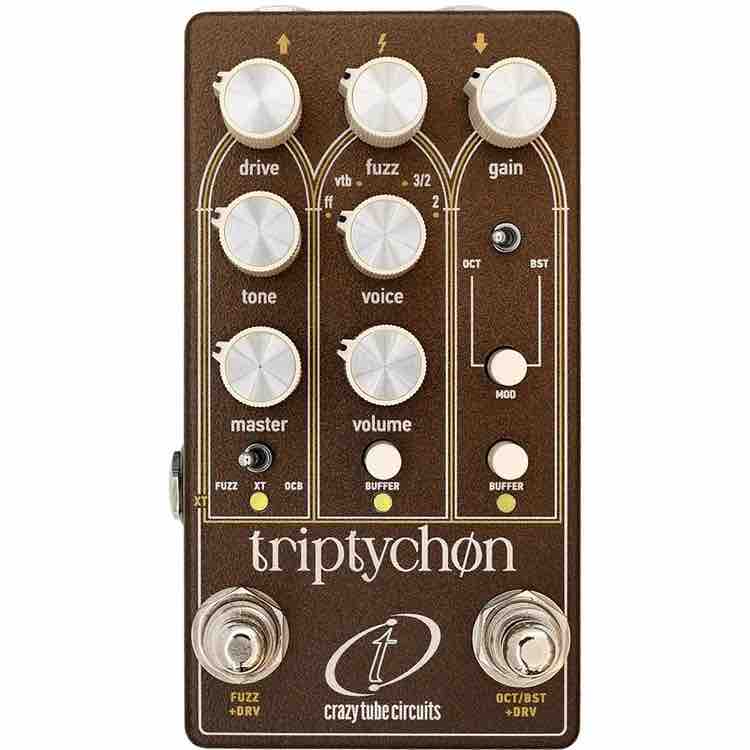
At the core of the Triptychon are three distinct sections that can be used independently or stacked for massive, harmonically rich textures.
1. The Vintage Fuzz Panel (Center)
The heart of the pedal is a 4-voice analog fuzz engine. While many vintage-style pedals rely on temperamental germanium transistors, Crazy Tube Circuits has used a custom six-metal-can silicon transistor design. This provides the warmth, “cleanup” response, and touch sensitivity of germanium with the stability and consistency of silicon.
-
Fuzz Face Mode: Smooth, touch-sensitive, and iconic.
-
Vox Tone Bender Mode: Bright, biting, and classic.
-
Tone Bender Mk1.5 & MkII Modes: From heavy saturation to a total “wall of sound.”
2. Boost & Upper Octave (Right)
This section adds harmonic expansion to your signal.
-
Boost Mode: Switch between a sharp, cutting treble boost or a warmer, mid-focused push.
-
Octave Mode: An upper-octave fuzz with two distinct flavors—one articulate and clear, the other thick and saturated.
3. The Amp Drive (Left)
Rather than a standard overdrive, this panel acts as a cranked tube amp simulator. It provides the necessary compression and “sag” that fuzz circuits need to shine. By shaping the overall response of the pedal, the Drive section ensures your fuzz never sounds thin or fizzy when running into a clean amp.
Smart Integration for Modern Pedalboards
One of the most innovative features of the Triptychon is the inclusion of switchable anti-buffer circuits.
Classic fuzzes often lose their “magic” when placed after wireless systems, buffers, or active pickups. The Triptychon’s anti-buffer restores the natural impedance and feel of a guitar plugged directly into a vintage circuit.
Key Technical Features:
-
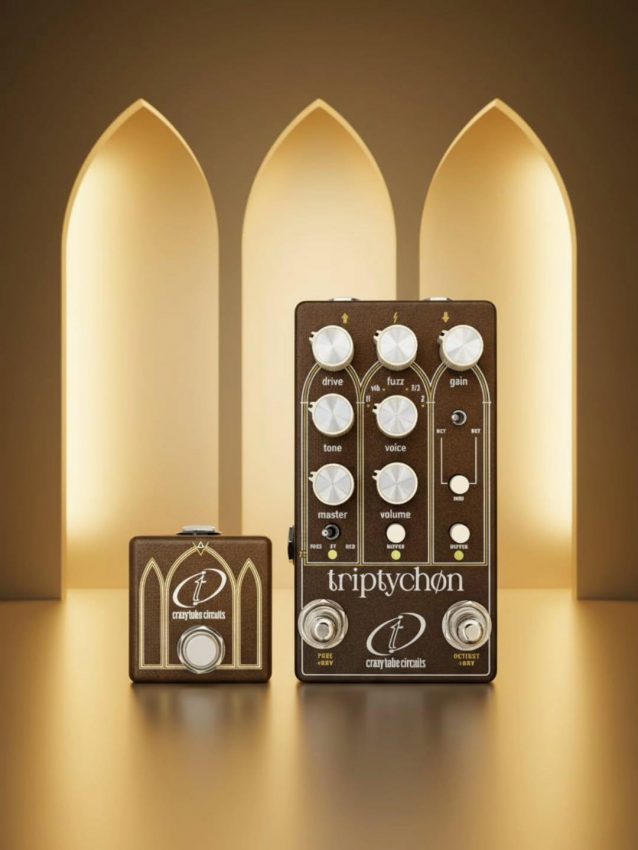
Assignable Switching: Link the Drive section to either the Fuzz or Boost footswitch for simplified operation.
-
XT External Support: Connect an optional external XT footswitch for independent control over the Drive section.
-
Hand-built Quality: Each unit is designed and hand-assembled in Athens, Greece.
Pricing and Availability
The Crazy Tube Circuits Triptychon is set to become a centerpiece for guitarists seeking premium vintage tones without the reliability issues of 60-year-old gear.
Available at Andertons – £269
Available at Thomann – €315



#Crazy Tube Circuits
This article may contain affiliate links to Andertons, DeathCloud, Donner, Fender, Gear4Music, Guitar Center, Positive Grid, Stew Mac, Sweetwater, and Thomann that help finance the running costs of GuitarBomb. We will receive a small commission if you buy something through these links. Don’t worry; you pay the same price, and it costs you no extra to use these affiliate links for your purchases.


