

There is a fine line between a guitar that looks like it has survived three decades of smokey dive bars, and a guitar that looks like it barely survived a targeted assault by an angry teenager with a belt sander.
Failed Guitar Relics
Over on The Gear Page, a recent thread titled “Failed Relics” has become a digital museum of horrors, celebrating the bizarre, the over-cooked, and the downright baffling world of artificial guitar aging.
For years, the guitar community has debated the merits of paying extra for pre-beaten instruments. But while the master builders at the top factories use artful precision, the internet’s DIY “luthiers” and a few over-zealous custom shops have proven that giving an instrument “character” often just looks like a cry for help.
To understand how deep this rabbit hole goes, one needs only to look at the current crop of “relic” guitars floating around the secondhand market. Here is a field guide to the finest examples of the craft, ranging from factory-sanctioned madness to “I found a Dremel in the garage” specials.
1. The “Crime Scene” Factory Relic
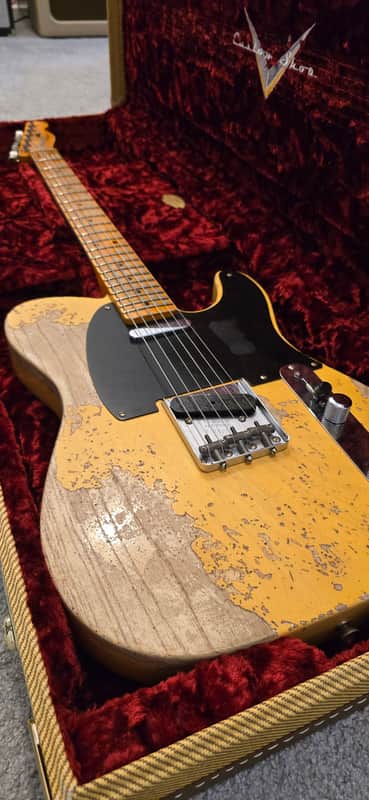
Example: Fender Custom Shop Limited Edition 1950 Double Esquire (Heavy Relic)
You would think spending thousands of dollars on an official Custom Shop model guarantees subtle elegance. Enter this 1950 Double Esquire in Nocaster Blonde.
The “Heavy Relic” designation here apparently translates to “looks like it was dragged behind a truck through a gravel pit, then left in a damp basement for forty years.”
The forearm wear is so aggressively symmetrical it looks less like natural friction and more like the guitar was attacked by a giant, angry beaver. It proves that even the pros can sometimes look at a perfectly good piece of wood and say, “You know what this needs? More existential dread.”
2. The Identity Crisis
Example: Epiphone (Gibson?) Les Paul Custom 1995 White Relic (Bolt-On)
Nothing says “authentic vintage mojo” quite like a 1995 budget Epiphone with a bolt-on neck that someone has aggressively scrubbed to look “faded.” The listing calls it a “White Relic Faded Rare,” which is a polite way of saying the finish has been sanded down until it resembles a half-melted block of government cheese.
The contrast between the pristine gold hardware and the violently scuffed plastic parts gives the distinct impression that someone started a relic job, panicked halfway through, and just gave up to go eat lunch.

3. The 1980s Lawnmover Incident
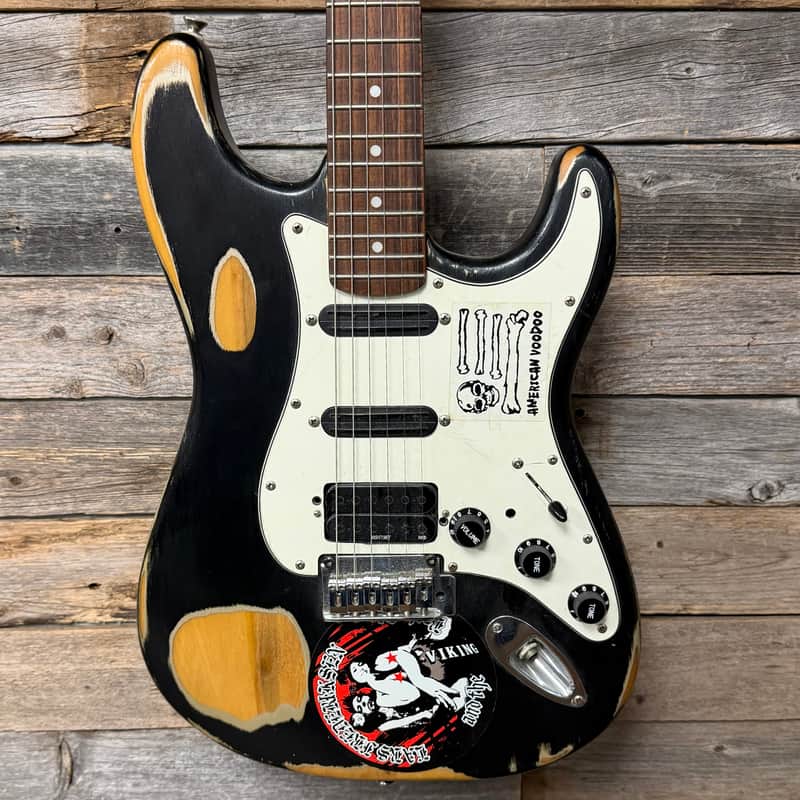
Example: Unknown Relic Strat-Style Shredder w/ Mighty Mite Mother Bucker
If you’ve ever wondered what a guitar looks like after being caught in an industrial woodchipper, this “unknown shredder” is your answer.
Featuring a “Mother Bucker” pickup (because of course it does), the body of this guitar has been subjected to a level of gouging that defies physics. The random gashes on the front look less like honest play-wear and more like the previous owner used it as a shield during a medieval broadsword battle. It’s not a relic; it’s a cry for a tetanus shot.
4. The Plywood Special
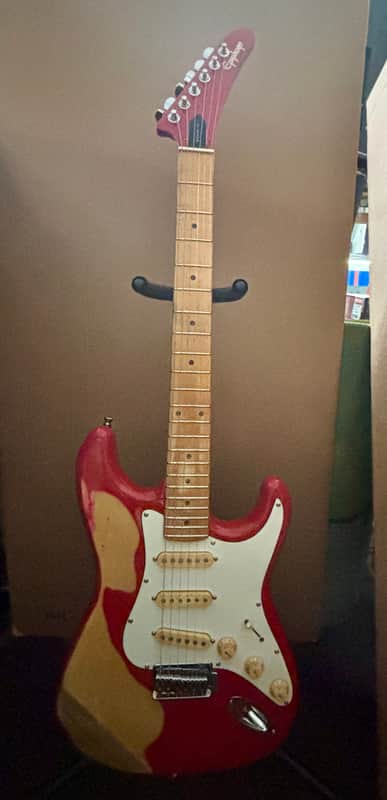
Example: Gibson Epiphone Strat-Style 1989 Korea
Ah, the late-80s Korean Strat copies. Famous for their… well, mostly just for existing. Someone looked at this humble instrument and decided it deserved the Stevie Ray Vaughan treatment.
Unfortunately, sanding down a budget guitar often reveals the dark secret beneath the paint: multi-ply laminate. The result is a relic job that exposes alternating layers of wood glue and plywood, making the upper horn look less like a vintage instrument and more like a topography map of the Andes mountains.
5. The “I Had a Can of Yellow Spray Paint” Partscaster
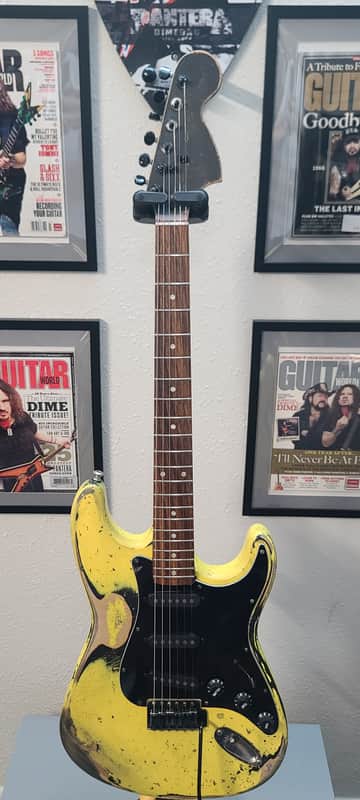
Example: Partscaster Stratocaster Yellow Relic
There is a specific genre of relicing that can only be described as “kindergarten art project.” This yellow Partscaster looks as though it was painted, allowed to dry for approximately four seconds, and then attacked with a wire brush.
The black “wear” marks look suspiciously like they were applied with a Sharpie or a charcoal stick, giving it the distinctive aesthetic of a cartoon instrument that just survived an explosion.
6. The Regal Nightmare
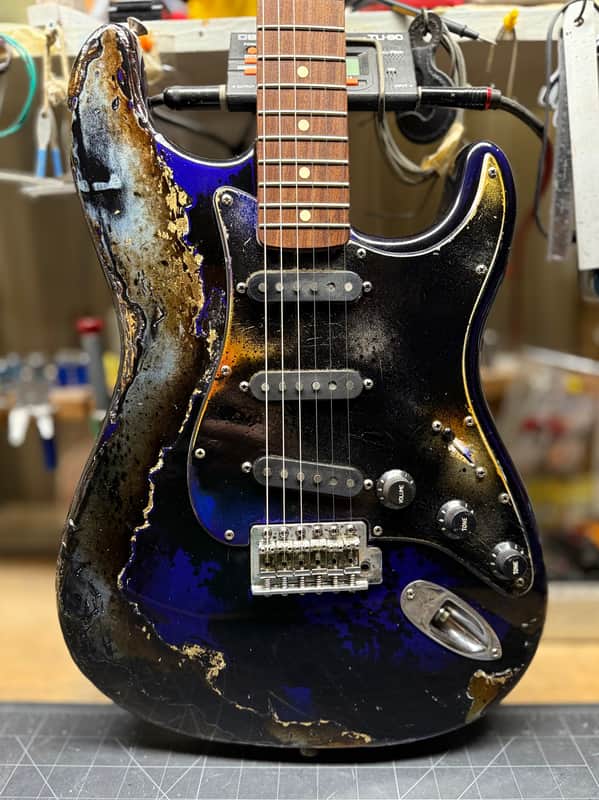
Example: Fender Stratocaster “Midnight Monarch” Purple/Gold Leaf Heavy Relic
Why stop at artificial wear and tear when you can add gold leaf? This Custom Shop creation attempts to blend high-end royalty with absolute destruction.
The deep purple finish is violently stripped away to reveal bare wood, which is then accented by gold trim. It looks less like an aged vintage guitar and more like a prop from a low-budget fantasy movie where the dark wizard’s scepter got run over by a chariot.
7. The Chemical Spill
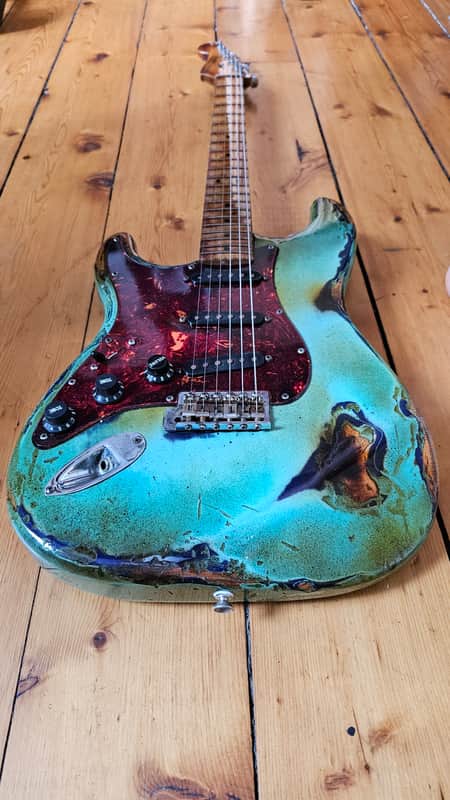
Example: Fender Stratocaster Surf Green Heavy Age Relic
Surf Green is one of the most beloved colors in Fender history. It is bright, cheerful, and redolent of 1960s California. This particular relic job, however, has turned that cheerful green into something resembling toxic sludge.
The simulated “aging” has given the finish a sickly, brownish-yellow crust that makes the instrument look like it was recovered from the bottom of a swamp or heavily exposed to a chain-smoker’s living room for half a century.
The Moral of the Story
As the denizens of The Gear Page will gladly tell you over the course of a 40-page argument, true relicing is an art form. It requires an understanding of how sweat, friction, and time actually interact with nitrocellulose lacquer.
When done wrong, it just looks like property damage. But hey, if you’ve always wanted a guitar that looks like it was used as a canoe paddle during an apocalypse, the secondhand market has never been riper. Just leave the sandpaper in the drawer, folks.
#Guitar Relics #Failed Guitar Relics
This article may contain affiliate links to Andertons, DeathCloud, Donner, Fender, Guitar Center, Positive Grid, Reverb, Sweetwater, and Thomann that help finance the running costs of GuitarBomb. We will receive a small commission if you buy something through these links. Don’t worry; you pay the same price, and it costs you no extra to use these affiliate links for your purchases.


