

In a market saturated with clones of the Octavia, Super Fuzz, and Tone Machine, JHS Pedals has announced a stark departure from the norm: the Coyote Octave Fuzz. Rather than retreading familiar ground, the Coyote resurrects an incredibly rare circuit that defies traditional octave fuzz topologies, bringing a forgotten piece of boutique pedal history to the masses.
The Coyote is a meticulous replication of the obscure “Moonrock Fuzz,” originally designed and built by the late G.S. Wyllie. Wyllie, a reclusive North Carolina builder, famously sandcast his own enclosures and etched his own boards.
Coyote
What sets the Coyote apart from traditional octave fuzzes is its highly unconventional use of a transformer. While standard circuits use transformers to generate the octave effect, Wyllie’s design places it elsewhere in the circuit to act as an inductive element. This unique placement shapes how the fuzz stage responds, directly contributing to the pedal’s swell, fuzz, and octave characteristics. According to JHS, the result is a texture and feel entirely unique in the pedal world.
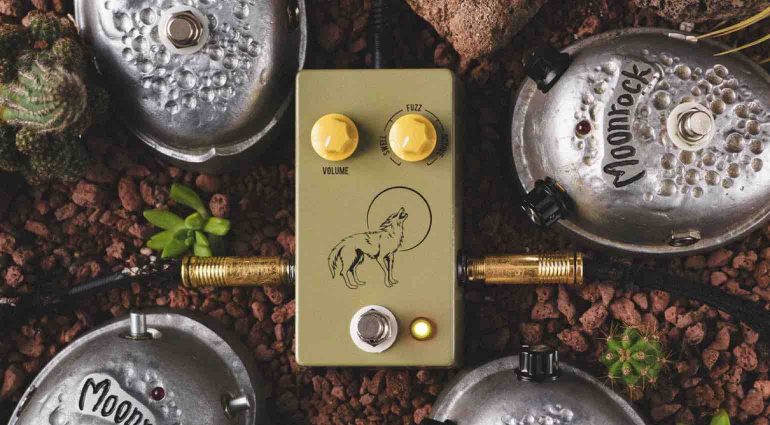
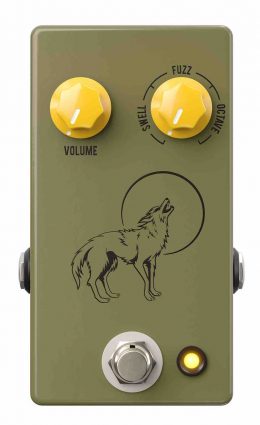
Swell / Fuzz / Octave
The pedal features a radically simplified control layout: a Volume knob and a single Swell / Fuzz / Octave control that continuously sweeps through three distinct sonic zones. At its lowest settings, it produces a gated, reverse-tape “swell” effect. At noon, it delivers a rich, aggressive fuzz akin to a Tone Bender. Fully clockwise, it roars into a snarling, Hendrix-style octave-up.
Remarkably, the Coyote also boasts touch sensitivity and volume-knob cleanup that is practically unheard of in the octave fuzz category, allowing players to tame the beast with simple picking dynamics.

The History: Glenn S. Wyllie, the “American Master”
The story of the Coyote is intrinsically tied to its elusive creator, Glenn S. Wyllie. Raised in New Jersey, Wyllie learned to read schematics from his electrical engineer father by the time he was twelve. At seventeen, inspired by The Rolling Stones’ “Satisfaction,” he built his first fuzz pedal. During the late 1960s, he even crossed paths with Jimi Hendrix several times in Greenwich Village, an encounter that fueled his lifelong pursuit of the perfect fuzz tone.
Wyllie eventually settled in the Appalachian foothills of North Carolina. Operating out of a home heated by a woodstove, he built pedals one at a time for those lucky enough to find him. Despite his reclusive nature, his pedals quietly made their way onto stages and recordings with legendary artists including Paul Simon, Bruce Springsteen, Stevie Wonder, David Byrne, and Joan Baez.
NYC guitarist Mark Stewart famously dubbed Wyllie an “unacknowledged American master.” Though he rightfully belongs in the pantheon of boutique pedal pioneers alongside names like Mike Fuller, Paul Cochrane, and Zachary Vex, Wyllie remained largely unknown. He passed away in 2014, still building pedals. Despite JHS Pedals’ best efforts to locate his family to share the news of this tribute project, Wyllie remains as elusive in death as he was in life—a true coyote.
Frequently Asked Questions (FAQ)
Q: How is the Coyote different from other classic octave fuzzes?
A: Almost all popular octave fuzzes are based on the Octavia, Super Fuzz, or Tone Machine circuits. The Coyote uses a completely unique topology designed by G.S. Wyllie, utilizing a transformer as an inductive element to shape the pedal’s response rather than to create the octave itself.
Q: What exactly does the Swell / Fuzz / Octave knob do?
A: It sweeps seamlessly through three distinct effects:
-
Swell (Counterclockwise): A gated, blooming effect with a reversed-tape character that responds to your picking attack.
-
Fuzz (Noon): A full, rich, aggressive fuzz in the vein of a classic Tone Bender.
-
Octave (Clockwise): An aggressive octave-up tone with snarling, even-order harmonics.
Q: Where should I place the Coyote in my signal chain?
A: Like most vintage-style fuzzes, it should go first in your chain. It is highly recommended to run it into another overdrive pedal or an already-overdriven amplifier to achieve iconic octave fuzz tones.
Q: How do I get the most pronounced octave effect?
A: Turn the main control fully clockwise, switch to your guitar’s neck pickup, and play above the 12th fret.
Q: Does it clean up when I roll back my guitar’s volume?
A: Yes. In a surprising twist for an octave fuzz, the Coyote is incredibly touch-sensitive. At lower settings on the main control, you can clean up the fuzz by rolling back your guitar’s volume or simply by picking lighter.
The Verdict
The JHS Coyote Octave Fuzz isn’t just a new pedal; it’s an act of audio archaeology. By resurrecting G.S. Wyllie’s brilliant, unconventional Moonrock circuit, JHS has delivered a three-in-one dirt box that genuinely sounds like nothing else on the market.
Who is it for? It is a must-have for tone chasers, doom players, blues explorers, and fans of Hendrix, Jack White, and Gary Clark Jr. If you are a “fuzz scavenger” who feels like you’ve played every variation of the classic circuits and are still searching for something wildly different yet deeply musical, the Coyote is your holy grail.
Pros:
-
Three entirely distinct, highly usable effects in one knob.
-
Unprecedented volume cleanup and dynamic response for an octave fuzz.
-
A truly unique circuit not found in standard production pedals.
Cons:
-
Requires specific placement (first in the chain) and an overdriven amp/pedal to sound its absolute best, which may not suit ultra-clean pedalboard setups.
Price & Availability
Available at Andertons – £149.99
Available at Sweetwater – $149
More Information
#JHS Pedals #Coyote
This article may contain affiliate links to Andertons, DeathCloud, Donner, Fender, Gear4Music, Positive Grid, Stew Mac, Sweetwater, and Thomann that help finance the running costs of GuitarBomb. We will receive a small commission if you buy something through these links. Don’t worry; you pay the same price, and it costs you no extra to use these affiliate links for your purchases.


