
This list presents the stompboxes I believe are the most flexible, reliable, and readily available. If you need a good overdrive or distortion for your guitar setup, this is the list for you. I’ve added a few basic tips to get the most out of each pedal.
Ultimate Drive Tone?
I have a huge collection of pedals myself and have been using pedals for over 35 years. This has given me some great insight into what makes a good drive pedal.
\Many players buy a new pedal and aren’t sure what to do with it. They turn all the controls up to maximum and miss out on all the best tones on offer. I’ll suggest some ways to get better results throughout the list, though I would stress that you really should experiment with those pedal controls, as that is where the magic happens.
Top 5 Distortion & Distortion Pedals
Often, we equate a distortion with more gain and an overdrive with less gain, yet both are great for kicking an already driven amp into distortion. And to some degree, I would agree with both of these statements.
Though there are pedals that certainly cross over between the two drive pedal styles. I’m not going to mention the subcategories of preamps, treble boosters, and fuzz pedals, as I want to keep this article focused to make it easier for beginners and anyone looking for help choosing a great drive pedal. I’ll cover each of these in separate articles, since I think they deserve their own write-ups.
What to look for
Ideally, I look for value for money, a robust pedal that will last a lifetime, and, finally, a great, flexible drive tone. I am not going to include any boutique pedals, as that is a rabbit hole, and many of them are based on the pedals in this list.
I’m not anti-boutique pedal, but if you are midway through a tour and your pedal needs to be replaced due to loss, theft, or breakdown. Then you need something you can buy easily, with no waiting list, and an effect you can purchase anywhere in the world.
Proco Rat 2 Distortion
The first drive pedal on my list is the Proco Rat 2 Distortion, and it is possibly one of my favorite distortion/overdrive pedals. You could classify it as a fuzz at the more extreme settings as well. These pedals are super simple to use and have many great settings that go from subtle to all-out carnage. This makes them super flexible and great for a variety of guitar amps.

One versatile rodent
The controls on the Rat 2 consist of Distortion, Filter, and Volume and the pedal itself is very robust. The filter control is the key to getting the best out of the pedal, and as you turn it clockwise, the tone gets darker. As it is a Low Pass filter. The drive tone is all silicon diode hard-clipping on the pre-amplified signal, creating symmetric distortion in a similar way to an MXR Distortion+ or the Boss DS-1.
Don’t hung up by the LM308 op-amp debate, and rather focus on how to dial in the Rat 2. These little black boxes have a ton of great tones available. Subtle tweaks really can open up what is on offer with this circuit so be prepared to tweak your rodent. A good example of a classic distortion tone would be to set the Distortion knob to around noon, the Filter knob to around 10 o’clock, and the Volume to around 2 o’clock.
Boss DS-1 Distortion
The Boss DS-1 Distortion is a stone-cold classic and has been used on countless recordings and by guitarists all over the world. It is the go-to drive tone for many players because it is so solid and also very versatile. The simple Level, Distortion, and Tone control layout is easy to use and super versatile. It also responds well to your playing dynamics, and if you know how to dial it in , then it will reward you with superb drive tones.

The Classic
The pedal creates its distortion tones via transistor stages with an op-amp core and hard clipping diodes. The secret with this DS-1 is to avoid high output pickups. It prefers lower-output pickups, like vintage-style PAF humbuckers and single coils. The circuit was created in the late ’70s and so these more vintage-style pickup outputs are what it was designed for.
The pedal works well with a slightly dirty amp tone and does not sound good in to a clean amp. I would suggest you leave it on and use your guitar’s volume knob to clean up the distortion, and think of it more as an extension of your guitar amp. Rather than as a stomp-on-and-off effect pedal. I have seen many players get it very wrong with the DS-1 just because they did not know how to use it.
Tips to dial in the DS-1
- Don’t turn the Tone control all the way up; keep it below the 9 o’clock position for the best tones, or it will bite your head off.
- The Distortion knob is best below the noon position; after that, it becomes messy as it compresses and gets overly saturated.
MXR Distortion +
Making the third place on my list is the classic MXR Distortion +, and again, this is a pedal born in the late ’70s. It doesn’t get much simpler and with only two controls, you could be fooled into thinking it is lacking in control. But those two knobs, labeled Output and Distortion, offer a myriad of amazing drive tones.

Classic Drive Tones
The MXR Distortion + uses germanium diodes and has a different character to the Rat 2 and DS-1 above. This pedal offers soft clipping, The way to get the most out of this MXR is to put it in front of an amp that is already breaking up, and then it will sing. I find the Distortion knob works best between 10 o’clock and 3 o’clock. Then set the Output knob to taste and off you go.
MXR Distortion + at Sweetwater
Boss BD-2 Overdrive
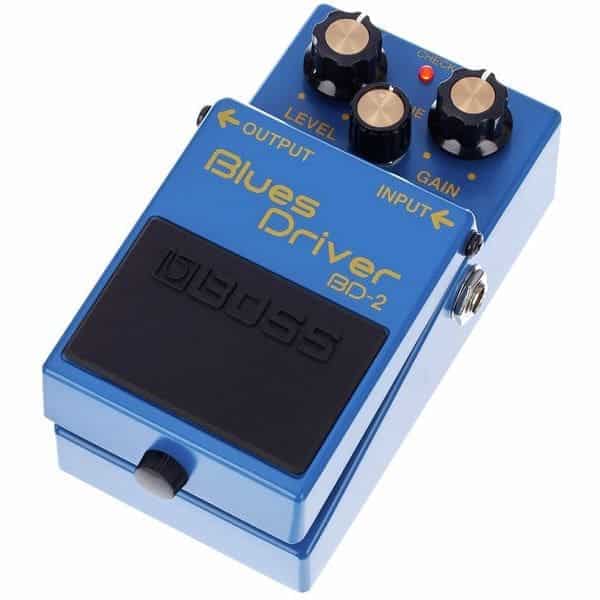
Number four on my list is the Boss BD-2 Overdrive, and this is the first one to offer more restrained, subtle drive tones, perfect for players who use single-coil pickups. I would describe the pedal as offering a more natural and vintage tube amp sound. Not as classic rock or hard rock as the previous three stompboxes on my list.
Subtle and Versatile
The BD-2 has three controls: Level, Tone, and Gain, which offer guitarists some very usable drive tones, with plenty of character. Like most simple control layouts, do not be fooled, as there are a lot of tonal variations within this simple-looking blue box. Unlike the DS-1 and the MXR Distortion +. the BD-2 will work well with a clean amp. Below are two settings you could try out to get your results straight away.
- Light Crunch – Try the Level at noon, Tone at 10 o’clock, and Gain around 9 o’clock
- Boost for solos – Level around 5 o’clock, Tone at 11 o’clock, and Gain at 8 o’clock
Boss BD-2 Overdrive at Andertons
Boss BD-2 Overdrive at Sweetwater
Boss BD-2 Overdrive at Thomann
Nobels ODR-1 BC
Finally, the Nobels ODR-1 BC is a pedal that offers some great, subtle, and more natural tube-amp-sounding drive tones. It has a reputation as a bit of a secret weapon among many session guitarists, and many have used it to create some amazing drive tones.

The Secret Sauce
With controls that consist of Driver, Spectrum, Level, and a Bass Cut switch, this little green pedal is potentially the most advanced of the units on this list. Turning the Spectrum knob clockwise increases the bass and treble; the midrange remains untouched. Then, to further add to the versatility, the pedal works with 9-18V DC for more headroom, and finally, there is also a Remote Output Socket that allows remote control via either an external switch or switcher system.
Tips
Use the Bass Cut switch when working with humbucker-style pickups and the extra headroom offered by 18 V operation is something you should use whenever possible.
The driven sound works well in most settings, but the magic happens in the lower reaches of the drive knob. I also really like that it does not suffer from the mid hump that you would associate with a TubeScreamer-style circuit. In the video below are a few good examples of drive tones, and settings you could try.

No TubeScreamer?
You will have noticed that two very popular drive pedals are missing from my list: the classic Ibanez TubeScreamer and Maxon TubeScreamer-style designs, both of which are many. The reason for this is that I will be writing about these separately very soon. The TubeScreamer I feel needs a deeper dive, so I will dedicate a whole article to that one. Then there is that little yellow box, which I adore, the Boss SD-1, and its latest Waza Craft edition, which expands the circuit further. Again, I have something special planned for that one as well, so be sure to check back.
Boss SD-1 Waza Craft at Andertons
Boss SD-1 Waza Craft at Sweetwater
Boss SD-1 Waza Craft at Thomann
Ibanez TubeScreamer at Andertons
Ibanez TubeScreamer at Sweetwater
Ibanez TubeScreamer at Thomann
Maxon TubeScreamer at Andertons
Maxon TubeScreamer at Sweetwater
Conclusion
In a world full of expensive, hard-to-find effects, there is a lot to be said for the “industry standards.” The Proco Rat, Boss DS-1, MXR Distortion+, Boss BD-2, and Nobels ODR-1 are the workhorses of the guitar world. They are built like tanks and available in almost any music store on the planet—which is exactly what you want when you’re mid-tour and need gear you can count on.
Each of these pedals offers a unique flavor of gain, but the common thread is their versatility. By following the tips above and resisting the urge to “dime” every knob, you’ll find that these affordable classics can hold their own against even the most expensive boutique alternatives. Happy playing, and keep an eye out for my next article, where I’ll be tackling the legendary TubeScreamer family!
More Information
This article may contain affiliate links to Andertons, DeathCloud, Donner, Fender, Gear4Music, Positive Grid, Sweetwater, and Thomann that help finance the running costs of GuitarBomb. We will receive a small commission if you buy something through these links. Don’t worry; you pay the same price, and it costs you no extra to use these affiliate links for your purchases.


One thought on “Top 5 Distortion and Overdrive Pedals and How To Use Them”
People talk very positively about the MXR Timmy. I have one, and I have to say it’s the best OD on my board. Not as transparent as advertised, but sweet sounding and vertical. Really allows you to shape the tone. Consider adding it to one of your lists.