Double Down: The Beginners Guide to Dual Guitar Amp Rigs
Master dual-amp and stereo guitar rigs: Learn signal splitting, amp pairing, wet/dry setups, and how pros like The Edge and David Gilmour achieve

If your guitar tone feels boxed in, flat, or swallowed up in a full band mix, the solution might not be a new overdrive pedal or an expensive guitar upgrade. It might be sitting right next to you: a second amplifier.
The secret weapon behind many legendary live and studio guitar tones is running multiple amplifiers simultaneously. Whether you want to blend distinct amplifier voicings to sculpt a unique hybrid signature or expand your soundscape with three-dimensional stereo effects, moving to a dual-amp rig completely transforms how your instrument feels and breathes in a room.
The Acoustic Magic of Dual Amps
Why does running two amplifiers sound so profoundly different from simply turning up a single amp?
When you play through a single mono speaker, sound waves radiate from one point source. When you split your signal across two physical amplifiers separated by several feet, you introduce spatial dispersion and acoustic reinforcement.
In the room, sound waves interact, phase-align, and create natural width and movement that a single speaker cabinet physically cannot replicate. It turns a two-dimensional tone into a living, breathing wall of sound.
This can be a great way to experiment with expanding your guitar sound, especially in the studio and when playing live. You don't need to lug around huge 100-watt amp heads and stacks; you can get great results using smaller 15-20-watt combo amps, for example.
Essential Gear Checklist
Before you start splitting signals, make sure your signal path is structurally sound. Here is what you need:
- Your Guitar: The foundation of your sound.
- Three Quality Instrument Cables: Standard shielded cables for connecting your guitar, splitter, and amplifiers. (Never use speaker cables for instrument-level connections, and never use instrument cables between a tube amplifier head and a speaker cabinet!)
- A Signal Splitter: An ABY pedal, a dedicated active splitter, or a stereo effects pedal.
- Two Amplifiers: Tube, solid-state, or a hybrid combination.
- Isolated Power Supply: Essential for preventing ground loops and maintaining a quiet noise floor when splitting signals.
Mastering the Signal Split: ABY and Buffer Pedals
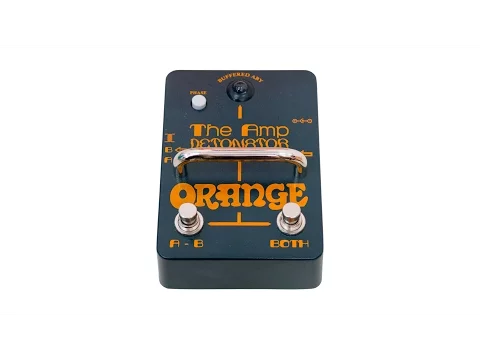
The gateway to a multi-amp rig is an ABY switcher or a splitter pedal. However, splitting a guitar signal passively can cause signal loss (loading) and introduce annoying electrical ground loops.
Why You Need Isolation
When you connect two independent amplifiers to the same guitar, you often create a ground loop, which results in a persistent 50Hz/60Hz mains hum. To combat this, choose an ABY box or splitter equipped with an isolation transformer (ISO) and a ground-lift switch (such as units from Radial Engineering or Lehle).
An isolated output breaks the electrical connection between the two amps while passing the audio signal cleanly, instantly silencing unwanted noise.
The Physics of Headroom, Wattage, and Speaker Efficiency
When pairing two amplifiers, success hinges on balancing headroom—the amount of clean volume an amp produces before it begins to distort. You want both amps to operate at comparable volume and gain levels so they complement rather than overpower each other.
Valve vs. Solid-State Power
Solid-state and valve (tube) amplifiers handle power and clipping differently.
- Valve amps compress musically as they approach distortion, yielding a perceived warmth.
- Solid-state amps remain aggressively linear until they hit a hard clipping ceiling.
The Power Rule of Thumb: A 15W tube amplifier generally needs to be paired with a solid-state amplifier of 50W or more to achieve balanced clean headroom in a live setting.
The Headroom Mismatch Trap
Imagine pairing a high-headroom 100-watt tube amp with a low-headroom 1-watt tube amp. The moment you step on a distortion pedal, the 100-watt tube amp retains massive clean headroom and leaps up in volume.
Meanwhile, the low-headroom 1-watt tube amp crosses its threshold instantly, compressing into heavy saturation without a matching jump in volume.
Your carefully balanced rig is suddenly thrown off, with one amp dominating the mix.
Iconic Amp Pairings Explored
Provided your amplifiers match roughly in power and headroom, the choice comes down to the sonic texture you want to achieve.
1. Fender & Marshall: Complementary Frequencies
The classic British-and-American blend made famous by players like Stevie Ray Vaughan.
- Fender Amps: Renowned for scooped midranges, warm low-end weight, and brilliant top-end sparkle.
- Marshall Amps: Characterized by an aggressive, forward midrange punch when cranked.
- The Result: They fill the gaps in each other’s frequency curves, delivering warmth and chime alongside driving muscle.
2. Vox & Marshall: “Mid-Stacking” Punch
For a grittier, rock-centric attack favored by tone-chasers like Joe Bonamassa.
- Marshall: Delivers lower-midrange heft and chunk.
- Vox: Accentuates upper-midrange bite and cutting crunch when overdriven.
- The Result: "Mid-stacking" creates a dense, rich profile that sits aggressively right in the middle of a dense band mix without stepping on the bass or cymbals.
Technical Hurdles: Phase Cancellation and Latency
Running two amps opens the door to a couple of technical gremlins that every tone purist should master:
Phase Cancellation
If two amplifiers are out of phase with each other (meaning their speaker cones are moving in opposite directions at the same time), the sound waves will cancel each other out in the room.
The result is a thin, hollow, nasal tone completely lacking in bass. The Fix: Look for an ABY pedal with a phase inversion switch (180°). Flipping it instantly restores your low-end thump.
Analog vs. Digital Latency
Mixing an all-analog amplifier with a digital modeler or multi-effects unit introduces a tiny, imperceptible processing latency in the digital path. When summed together acoustically in the room, this micro-delay puts the signals out of phase. Rule of thumb: Pair analog with analog, or digital with digital.
Core Dual-Amp Rig Configurations
1. The Dual Mono Setup
Dual mono is the easiest multi-amp configuration. Your signal splitter sits at the end of your chain, sending an identical mono signal to both amplifiers.
- Best For: Incredible tonal blending, a wider sonic footprint, and massive stage presence without complex routing.
- The Catch: Modulation effects (like tremolo or chorus) occur simultaneously on both sides, without spatial panning.

2. The Wet/Dry Setup
A favorite among professional session players, the Wet/Dry rig splits your signal so that core "dry" tones (compression, boosters, overdrives, fuzz, and wah) go to one amplifier, while spatial "wet" effects (delays, reverbs, and lush modulation) route exclusively to a second amplifier.
- Best For: Keeping your fundamental guitar tone punchy, articulate, and un-muddied, while spatial effects bloom freely in the background without washing out your attack.

3. The True Stereo Setup
A true stereo rig utilizes stereo-capable effects pedals (such as offerings from Strymon, Meris, Walrus Audio, Eventide, or Old Blood Noise Endeavors) positioned at the end of your signal path.
- Best For: True spatial movement. Panning delays, ping-pong echoes, and sweeping stereo modulations bounce dynamically across the left and right speakers, creating an immersive, cinematic soundstage.

Modern Alternatives: Stereo Modeling & FRFR Rigs
If lugging two physical tube amplifiers and heavy speaker cabinets to every gig sounds exhausting, modern digital modelers offer a streamlined solution. Units like the Neural DSP Quad Cortex, Line 6 Helix, Kemper Profiling Amp, and Valeton GP-200 pack dual-amp routing, studio-grade effects, and true stereo outputs into a single floorboard.
- You can design dual-path patches that internally replicate dual-mono, wet/dry, or true-stereo topologies.
- You can send stereo signals directly to the front-of-house PA system or to FRFR (Full Range Flat Response) monitors, bypassing heavy lifting while retaining massive, studio-quality tone on stage.
Legends of the Dual-Amp Rig: How the Pros Do It
You do not have to look far to see how multi-amp and stereo configurations have shaped guitar history. From soaring stadium soundscapes to razor-sharp fusion articulation, some of the world's most iconic players rely on dual and multi-amp routing to achieve their signature voices:
- The Edge (U2): Famed for his spatial, echo-laden soundscapes, The Edge often employs a wet/dry rig to let his signature delays bloom without washing out his core guitar attack, proving that versatility is key.
- David Gilmour (Pink Floyd): Utilizes wet/dry configurations to construct his vast, atmospheric, and emotive soundscapes, allowing atmospheric modulation and ambient delays to float effortlessly behind his core tone.
- John Petrucci (Dream Theater): A master of high-gain precision and massive cleans who has famously utilized wet/dry/wet configurations (running his JP2C head setup) to inject staggering three-dimensional depth into his technically complex playing.
- Steve Vai: Employs sophisticated wet/dry setups to maintain crisp note definition and build a massive stereo soundstage amidst dense, otherworldly effects chains.
- Eric Johnson: Known for his legendary, meticulous pursuit of tone, Johnson orchestrates complex multi-amp routing to achieve his trademark harmonically rich, velvety sustain and complex harmonic balance.
- Brad Paisley: Uses an intricate multi-amp setup to ensure his lightning-fast, hybrid-picked country lines jump out with crystal-clear articulation. (His tech, Chad Weaver, once noted that entire rigs are even swapped live for distinct drive characters).
- Scott Henderson: Relies on a wet/dry configuration in fusion playing to seamlessly blend clean and overdriven tones, maintaining punch, dynamics, and note separation under heavy improvisation.
- Carlos Santana: Achieves his singing, liquid sustain partly by splitting his signal across multiple amplifiers, keeping his soulful lead lines defined and free of mud.
- Joe Bonamassa: A modern blues-rock player who leverages multi-amp setups and careful volume/tone management to retain ferocious mid-stacking grit without sacrificing clarity.
Getting Started With Your Dual-Amp Setup
Stepping into the world of stereo and multi-amplifier rigs is one of the most rewarding journeys a guitarist can embark on. Whether you are dusting off an old backup combo amp to blend with your primary rig, experimenting with a pristine wet/dry signal path, or unleashing ambient soundscapes through a true stereo pedalboard, splitting your signal opens up an entirely new dimension of depth, texture, and inspiration.
There are no rigid rules in the pursuit of tone—only possibilities. Grab a reliable splitter, plug in a second amplifier, and start experimenting until you find the massive, living sound that truly speaks to your style.
The key is experimentation, and if you have access to more than one amp, it is worth the small effort to use two amps at once.
- +Creates three-dimensional spatial depth and acoustic reinforcement
- +Allows blending of distinct amplifier voicings and frequency characteristics
- +Enables wet/dry separation for clarity and definition
- +Works with affordable 15-20W combo amps, not just large stacks
- +Legendary players across genres rely on dual-amp configurations
- −Introduces ground loops and 50Hz/60Hz hum without proper isolation
- −Risk of phase cancellation if amplifiers are out of phase
- −Headroom mismatch between amps can throw off carefully balanced rigs
- −Requires additional investment in quality signal splitters and cables
- −More complex signal routing and setup compared to single-amp rigs
What's the main reason to run two guitar amplifiers instead of one?
Two amplifiers separated by space create natural acoustic reinforcement, phase alignment, and width that a single speaker cannot replicate. This turns a flat two-dimensional tone into a living, three-dimensional wall of sound with vastly improved presence in a band mix.
Do I need a special pedal to split my signal between two amps?
Yes. An ABY switcher or active splitter is essential to avoid signal loss and ground loops. Look for units with an isolation transformer and ground-lift switch (like Radial Engineering or Lehle) to eliminate 50Hz/60Hz hum when connecting two independent amplifiers.
What's the difference between wet/dry and true stereo setups?
Wet/dry splits your signal so dry effects (compression, overdrive, fuzz) go to one amp and wet effects (delays, reverbs, modulation) route to a second amp, keeping your core tone punchy. True stereo uses stereo-capable pedals that pan delays and effects dynamically across left and right speakers for immersive movement.
Can I pair a tube amp with a solid-state amp?
Yes, but balance headroom carefully. A 15-watt tube amp generally needs a 50-watt solid-state partner to maintain comparable clean volume before distortion. Mismatched headroom causes one amplifier to dominate when you engage drives or boosts.
Keep browsing

Get this stuff first.
Leaks, deals and reviews in your inbox, once a week. No spam, just gear.