Kurt Cobain's Nevermind Gear: Guitars, Amps & Pedals
Explore Kurt Cobain's exact Nevermind gear: the '69 Mustang, Boss DS-1, ProCo RAT, EHX pedals, Mesa Boogie & Fender amps that defined grunge.

When Nirvana dropped Nevermind in the fall of 1991, it didn't just change the trajectory of popular music; it sent millions of guitarists scrambling to replicate that massive, angsty, wall-of-sound guitar tone. We’ve all been there—huddled around a humming practice amp, diming the gain knob, and aggressively strumming power chords in a desperate attempt to channel Kurt Cobain.
But what gear actually went into making one of the most defining rock albums of the 90s? Thanks to producer Butch Vig's meticulous documentation and gear historians' deep dives, we have a remarkably clear picture of what happened at Sound City Studios. Spoiler alert: it involved a mix of pawn-shop prizes, high-end studio trickery, duct tape, and a whole lot of left-handed offset guitars.
As a massive offset fanatic myself—which is exactly why we built the free Offset Guitar Builder right here on the site—I've always been fascinated by Kurt's anti-boutique approach to tone. Let's break down the exact guitars, amps, and effects Kurt Cobain used to record and play live during the Nevermind era, and how you can capture a bit of that grunge magic yourself.
Pre-Nevermind
Before the polished, Butch Vig-engineered perfection of Nevermind, Nirvana was an entirely different, far more chaotic beast. I can distinctly remember standing in the crowd at the London Astoria back in December 1989 for the legendary Sub Pop Lamefest UK gig, watching a wildly raw, Bleach-era Nirvana absolutely tear up the stage.
I was there to see Mudhoney, as they were my favorite band at the time, but I was also into TAD, and Nirvana were a nice added bonus.

They weren't even the main event that night—they were actually at the bottom of the bill, opening for their Seattle grunge brethren Tad and the mighty headliners, Mudhoney. Kurt spent half the set battling technical difficulties, battling his gear, and snapping guitar strings, but the sheer, ferocious energy radiating from the stage was undeniable.
Yet, instead of derailing them, the tension fueled an electrifying performance that saw Krist Novoselic whirling his bass like a weapon and the band tearing through tracks like "School" and early versions of "Breed" (then called "Imodium"). Despite the shoddy gear and their miserable mood, the sheer, ferocious energy of their set blew the roof off the Astoria, causing the UK music press to hail them as the next massive thing and setting the stage for the global explosion that Nevermind would ignite just two years later.
It was scrappy, earsplittingly loud, and gloriously unrefined—a stark contrast to the massive, dynamic tone they would capture on tape just two years later—but even then, sweating it out in that Astoria crowd, it was incredibly obvious that something huge was brewing.
The Guitars Behind the Grunge
Kurt wasn't a cork-sniffer when it came to guitars. He favored quirky, often cheap instruments that could take a beating. He was naturally drawn to Fender offsets, which hair-metal shredders largely ignored at the time and could pick up for a steal at pawn shops.
These cheap guitars became some of the models he was seen playing on tour around the time of Nirvana's rise to worldwide fame.
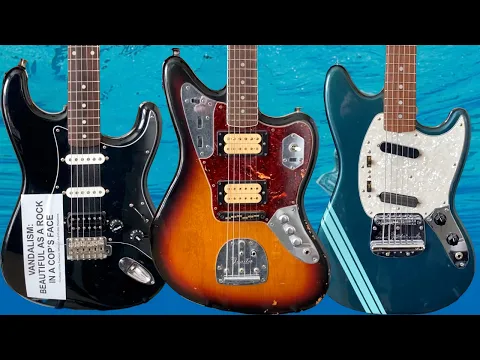
1965 Fender Jaguar
This heavily modified ’65 Fender Jaguar became one of Cobain’s most-used instruments, both on stage and later in the studio. Outfitted with dual DiMarzio humbuckers instead of the traditional single-coils, it offered a much fatter, hotter output than a stock Jag.
It had an incredibly distinctive look with its bound fingerboard, dot inlays, and an added toggle switch on the lower horn.
Fender now sells a recreation of this specific offset model. It is the one many people associate with Cobain, but it was probably not used to record on Nevermind.

1969 Fender Competition Mustang
Arguably his most famous guitar thanks to the "Smells Like Teen Spirit" music video, this Lake Placid Blue ’69 Fender Competition Mustang (with matching headstock) was a primary weapon live and may have been on the recordings at some point (supposedly to track rhythm parts on various tracks). Interestingly, during the actual recording sessions, this guitar was still completely stock with its original single-coil pickups.
It later received the infamous Seymour Duncan Hot Rails in the bridge position and a hardtail Gotoh Tune-o-Matic bridge to withstand his notoriously aggressive playing style.


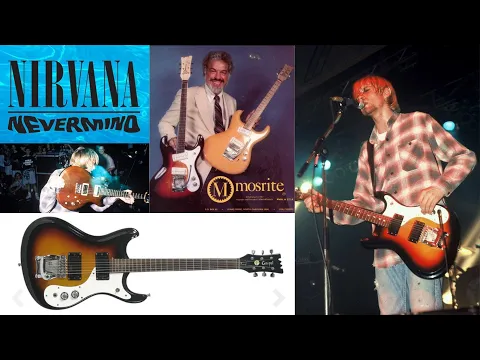
Mosrite Gospel Mark V & The Smashed Strats
For a different flavor, Kurt utilized a Mosrite Gospel (technically a Gospel-branded Ventures Model Mark V). It was an oddity, like many of his choices, and he often used it on tracks tuned down to D standard. It was the model most associated with recording the album tracks.
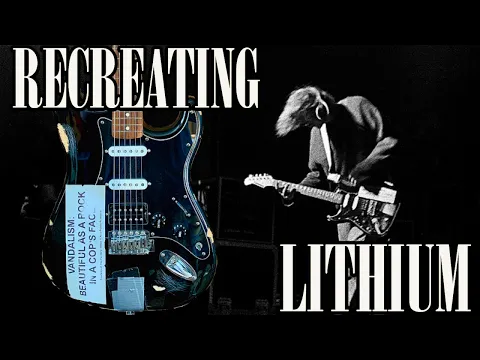
Then, there were the Stratocasters. Mostly cheap, Japanese-made Fender models Kurt bought specifically because he didn't mind destroying them. The black Stratocaster that met its demise at the chaotic end of "Endless, Nameless" is a legendary piece of studio collateral damage.
The $20 Stella H912 12-String Acoustic
Perhaps the most humorous piece of the Nevermind puzzle is the acoustic guitar used on "Polly" and "Something in the Way." Kurt bought a Stella H912 12-string acoustic from a Denver junk shop for twenty bucks.
He removed six strings, leaving it as a standard 6-string. The tuning keys were so loose they had to be held in place with actual duct tape. Butch Vig noted that the original strings were left on it, describing the tone as incredibly "plunky." Yet, mic'd up with a high-end AKG 414 condenser microphone, that cheap, battered box produced some of the decade's most haunting, intimate acoustic tones.

Amplifying the Angst: The Amps
While Kurt's guitar choices were scrappy, the amplifier setup for Nevermind was surprisingly sophisticated, and Butch Vig orchestrated it to create massive dynamic shifts.
Mesa Boogie Studio Preamp & Crown Power Base 2
For the tighter, more focused verses, Kurt frequently ran his guitar into a Mesa Boogie Studio Preamp. Instead of a traditional guitar power amp, this was patched into a robust Crown Power Base 2 solid-state power amplifier. This combination delivered a pristine, clinical clean tone and a tight, articulate overdrive that cut through the mix without muddying the bass frequencies.
Fender Bassman
When the choruses hit and the song needed to explode, Vig had Kurt switch over to a Fender Bassman. The Bassman is legendary for its thick, saturated low-midrange push. By layering the tight Mesa Boogie sound in the verses with the massive, roaring Fender Bassman in the choruses, Nirvana achieved that iconic loud-quiet-loud dynamic that became the blueprint for 90s alternative rock.
Vox AC30
For some of the cleaner, chiming overdubs, particularly on "Come As You Are," Vig utilized a classic Vox AC30. It added a gorgeous, airy top-end shimmer without getting overly processed by effects.
Stomping on Tone: The Pedals
While I absolutely love building intricate signal chains and gain-stacking with boutique pedals like my Wampler Velvet Fuzz or my old '73 Sola Sound Tone Bender in my own studio work, Kurt's pedalboard on Nevermind was famously minimal. He relied on just a handful of mass-produced boxes to get the job done.
| Pedal | Primary Role | Key Songs |
| Boss DS-1 | Main rhythm distortion, pushed into a clean amp | Smells Like Teen Spirit, In Bloom |
| ProCo RAT | Aggressive, fuzzy distortion, often split-signal | Breed, Territorial Pissings |
| EHX Small Clone | Deep, watery chorus modulation | Come As You Are, Smells Like Teen Spirit |
| EHX Big Muff Pi | Dark, thumping, apocalyptic fuzz | Lithium |
Boss DS-1 Distortion
The heart of Kurt's dirty tone. The Boss DS-1 is a stone-cold classic, and we’ve sung its praises extensively on the site, including in our feature on the Top 5 Distortion and Overdrive Pedals.
Kurt's go-to setting for rhythm parts was incredibly aggressive: level maxed out, tone around 10 o’clock, and distortion sitting at about 4 o'clock. Running this harsh, fizzy pedal into the massive headroom of a clean amp was the secret sauce of the grunge movement.

ProCo RAT
As someone who has spent years gigging with an early '80s ProCo RAT, I can attest to the magic of this circuit. On Nevermind, the RAT was deployed for a more aggressive, grittier texture than the DS-1. For tracks like "Breed," the RAT's signal was split—one output went to an amplifier, and the other was routed directly into the recording console via a DI (Direct Injection) box. This created a fiercely layered, razor-sharp punk rock tone.

Electro-Harmonix Small Clone & Big Muff Pi
Kurt’s modulation needs came almost exclusively from the EHX Small Clone. With its single depth switch and rate knob, it produced the iconic "watery" shimmer heard on the "Come As You Are" riff and the pre-chorus build-up of "Smells Like Teen Spirit." If you want that exact sound in your DAW today, it's easier than ever—check out our review of how analog icons are going digital with the EHX plugin suite.
When he needed total sonic destruction, he stomped on an EHX Big Muff Pi, which provided the dark, thumping fuzz tone that drives "Lithium."

The Nevermind Tone Formula: Song-by-Song
Understanding the gear is one thing, but seeing how Butch Vig assembled it track by track reveals the album's production genius.
- Smells Like Teen Spirit: The blueprint. Japanese Fender Stratocaster equipped with a Seymour Duncan JB bridge humbucker through the Bassman amp. The DS-1 provides the dirt, while the Small Clone adds that wobbly, eerie modulation during the pre-chorus and the guitar solo.
- In Bloom: A masterclass in dynamics. Kurt tracked the verses using the Mesa Boogie Studio Preamp for a tight, controlled sound, then stomped on the DS-1 and switched over to the Bassman for the gargantuan, multi-tracked choruses.
- Come As You Are: The signature track for the Small Clone chorus pedal. Vig likely used the Vox AC30 here to keep the clean tones chiming and present without getting muddy under the heavy modulation.
- Breed & Territorial Pissings: Pure punk energy. The ProCo RAT takes center stage, but it’s the studio technique of blending the mic'd amplifier signal with a direct DI signal that makes the guitars sound like they are ripping through the speakers.
- Drain You: This track required some serious problem-solving. Early takes with the Mesa Boogie were deemed too "scratchy" and grating. The solution? Kurt switched back to the Fender Bassman, blasted the ProCo RAT into it, and laid down multiple takes. The thick, saturated result is one of the heaviest tones on the record.
- Endless, Nameless: Captured completely live at the end of a frustrating session where Kurt kept messing up a take. He finally lost his temper, obliterated the cheap black Stratocaster he was holding, and the tape kept rolling. It’s raw, unfiltered, and entirely unplanned.

Butch Vig’s Studio Wizardry
While Kurt brought the riffs and the attitude, Butch Vig brought the microphone techniques that captured them perfectly. Vig rarely relied on just one mic. He typically placed a Shure SM57, a Neumann U87, and an AKG 414 (or sometimes a Sennheiser 421) right up against the speaker grille.

Instead of blending them into a wash, he would listen carefully and pick the single best-sounding microphone for the final mix. To ensure perfect mic placement, Vig would crank the amp to full volume without a guitar plugged in.
He’d listen to the amplifier’s "hiss" (acting as a white noise generator) to check for phase coherence, moving the microphones millimeter by millimeter until the hiss sounded perfectly clear and full. He also avoided ambient "room" mics, keeping the guitar tracks dry, direct, and aggressively "in your face."

Kurt Cobain — Nevermind Rig Signal Flow

The Legacy of the Tone
Over thirty years later, the guitar tone on Nevermind remains a gold standard. It proves that you don't need a rack full of $3,000 boutique amps and meticulously hand-wired transparent overdrives to make history. You just need the right attitude, a couple of robust stompboxes, an offset guitar, and maybe a little duct tape to keep the tuners from falling off.

If reading this has you itching to design your very own grunge machine, don't forget to head over to the Guitar Bomb Offset Guitar Builder and start spec'ing out your dream Jaguar or Mustang right in your browser. And if you're chasing that tone on a budget, grab yourself a used Boss DS-1, crank the volume, and let it rip.
- +Minimal, accessible pedalboard proves you don't need boutique gear for iconic tones
- +Offset guitars were cheap and widely available at pawn shops in the early 90s
- +Boss DS-1 and ProCo RAT remain affordable and widely used today
- +Dynamic amp switching between Mesa Boogie (tight) and Bassman (massive) created signature loud-quiet-loud dynamic
- +Butch Vig's meticulous mic placement technique is replicable and documented
- +Duct-tape-held-together $20 acoustic produced haunting tones when properly mic'd
- −Requires careful studio production and mic placement to replicate—not just pedal-and-play tone
- −Original gear now commands premium prices at auction (Mustang sold for $4.5 million)
- −Tone is studio-produced and heavily dependent on Butch Vig's engineering choices
- −Attempting to recreate exact signal flow requires multiple amps and a DI setup
What guitar did Kurt Cobain use on Nevermind?
Kurt primarily used a 1969 Fender Competition Mustang in Lake Placid Blue and a modified 1965 Fender Jaguar with DiMarzio humbuckers. He also used a cheap Mosrite Gospel and Japanese Stratocasters. For acoustics, he played a $20 Stella H912 12-string with duct-taped tuning pegs.
What pedals did Kurt Cobain use on Nevermind?
Kurt's pedalboard was minimal: a Boss DS-1 distortion for main rhythm parts, a ProCo RAT for aggressive textures, an Electro-Harmonix Small Clone for chorus on tracks like 'Come As You Are,' and an EHX Big Muff Pi for the dark fuzz on 'Lithium.'
What amps did Nirvana use to record Nevermind?
Kurt switched between a Mesa Boogie Studio Preamp with Crown Power Base 2 for tight verses, and a Fender Bassman for massive, saturated choruses. A Vox AC30 was used for some cleaner, chiming overdubs on tracks like 'Come As You Are.'
Keep browsing

Get this stuff first.
Leaks, deals and reviews in your inbox, once a week. No spam, just gear.