Playable Guitar With No Neck or Body: Cable-Suspended Telecaster
Burls Art builds a fully playable cable-suspended guitar with no body or neck, using steel aircraft cables, turnbuckles, and a metal bed frame.

Popular YouTube channel Burls Art is known for his unconventional guitar builds, but his latest project might be his most extreme experiment yet. He has built a fully playable electric guitar stripped of its wooden core—meaning no body and no neck. Instead, the entire instrument relies on 1/16-inch steel aircraft cables, turnbuckles, and an upcycled metal bed frame to hold the structural tension.
How Do You Build a Guitar Without Wood?
The engineering behind this build is a delicate balancing act of competing physical forces. After testing a sketchy prototype on his workbench, Burl salvaged an old metal bed frame to act as the primary, rigid chassis.
To mimic the path of a traditional guitar neck and body, steel cables were suspended between the upright ends of the frame.
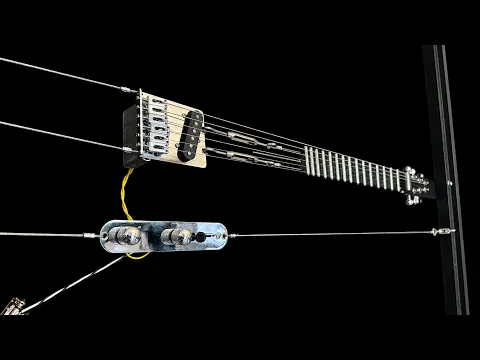
Because there is no solid wood to route or screw hardware into, standard guitar components had to be adapted to "float" on the wire rigging:
- The Bridge: A traditional Ashtray-style Telecaster bridge was chosen because its large base plate provided enough surface area to drill and mount directly onto the parallel cables.
- The Frets: Burl used a 3D printer to create custom fret holders from black PETG filament to camouflage them against the dark background. After experimenting with various metals and discovering how crucial fret mass is for sustain without a neck, he settled on heavy 5/16-inch stainless steel dowel pins. The sheer size of the dowels and their threaded rod mounting method capped the instrument at a 15-fret maximum.
- The Electronics: A standard Telecaster control plate and a single bridge pickup were wired to an output jack, all floating on an auxiliary cable setup below the main strings.

Playability and the Tuning Balancing Act
While the guitar features a familiar 25.5-inch scale length, playing it is an entirely alien experience. Without a physical neck, the player has nowhere to anchor their palm or thumb except awkwardly against the backs of the 3D-printed fret holsters.
Tuning the instrument is also a monumental challenge. Because the entire structure relies on interconnected tension rather than a rigid wooden chassis, tightening one string pulls the bridge and throws the other strings out of pitch.
It requires a tedious, progressive balancing act to get the guitar pitch-perfect. However, this flexible tension does allow for a unique parlor trick: players can physically push the cables laterally to create a manual pitch-shifting tremolo effect.
The Tonewood Debate: Does It Have Sustain?
When plugged in and compared directly to a standard solid-body Mexican Fender Telecaster, the sonic differences were night and day. The cable-suspended guitar suffers from an extreme lack of sustain and produces a remarkably hollow, plucky tone.
As Burl notes in the build video, the project highlights exactly why standard electric guitars are built the way they are.
It underscores just how vital the mass and rigidity of a traditional guitar neck, fretboard, and body are to transferring string resonance.
While it won't be replacing anyone's primary gigging guitar anytime soon, this cable-suspended build is a fascinating deep dive into guitar physics and structural tension.
- +Innovative exploration of guitar physics and structural tension
- +Unique manual pitch-shifting tremolo effect via lateral cable movement
- +Demonstrates the critical importance of mass and rigidity in traditional guitar design
- −Extremely poor sustain compared to conventional guitars
- −Hollow, plucky tone unsuitable for most playing styles
- −Tedious tuning process due to interconnected tension system
- −Awkward playability with no ergonomic neck anchor points
- −Limited to 15 frets due to dowel rod construction constraints
How does a guitar work without a body or neck?
The cable-suspended guitar uses a rigid metal bed frame as its chassis, with parallel steel aircraft cables connecting the frame's upright ends to hold structural tension. Standard guitar hardware—bridge, pickups, and controls—are mounted directly onto these floating cables rather than into wood.
Can you actually play this cable guitar?
Yes, it's playable but awkward. The 25.5-inch scale length is standard, but there's nowhere to anchor your palm or thumb except against the 3D-printed fret holsters. Tuning is extremely tedious because tightening one string throws others out of pitch due to the flexible, interconnected tension system.
What does the cable-suspended guitar sound like?
Compared to a standard Fender Telecaster, it produces an extremely hollow, plucky tone with virtually no sustain. This underscores how vital the mass and rigidity of a traditional wooden neck and body are for transferring string resonance and creating proper guitar tone.
Keep browsing

Get this stuff first.
Leaks, deals and reviews in your inbox, once a week. No spam, just gear.