

The Fender Stratocaster did not emerge fully formed and evolved over the first decade of its life. When the Stratocaster debuted in 1954, it was an undeniably groundbreaking piece of industrial design, but it wasn’t yet the refined masterpiece we know today. It actually took nearly a decade of real-world testing, marketplace friction, and factory adjustments before the Stratocaster achieved its definitive, culture-shaping dominance.
We can blame Leo Fender for this beautifully moving target. He wasn’t a traditional luthier; he was an inventor and a relentless tinkerer. Driven by a pure engineering mindset, Leo constantly chased the next marginal gain, the next manufacturing efficiency, and the next tonal improvement.
Because he designed the Stratocaster to be an inherently modular instrument, it became the ultimate canvas for ongoing experimentation—a process that began the moment it hit the factory floor and involved real-time input from notable ’50s players, music stores, and trusted advisers.
The 1954 Blueprint: The Original Recipe
Whatever your thoughts are on the modern-day Fender, Leo Fender was a genius, and this article celebrates one of his most famous designs.
To understand how the Stratocaster evolved, we have to look at the raw baseline established in the autumn of 1954.
The guitar’s development required a tight-knit village of passionate engineers, aggressive sales executives, and working musicians.
While official assembly-line production is noted as beginning on October 13, 1954, factory manager Forrest White later clarified that roughly 200 pre-production or artist models had slipped out of the factory earlier that spring.
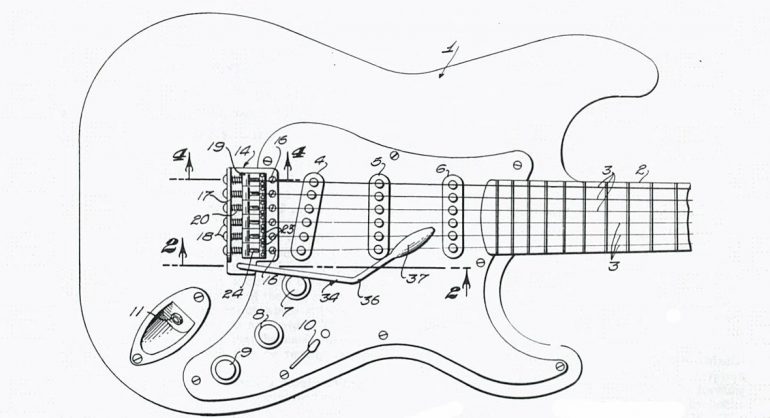
When the commercial model finally landed in music stores, it carried a premium price tag: $249.50 with tremolo ($229.50 for the hardtail version).
The Economics of Innovation: In 1954, $249.50 was a serious investment—the equivalent of roughly $2,839 today. Fender sales lead Don Randall had specifically requested an upscale instrument to go toe-to-toe with Gibson’s premium Les Paul. To put it in perspective, a musician in 1954 could choose between buying six brand-new Stratocasters or a brand-new Chevy Bel Air sedan ($1,685).
Core Launch Specifications
-
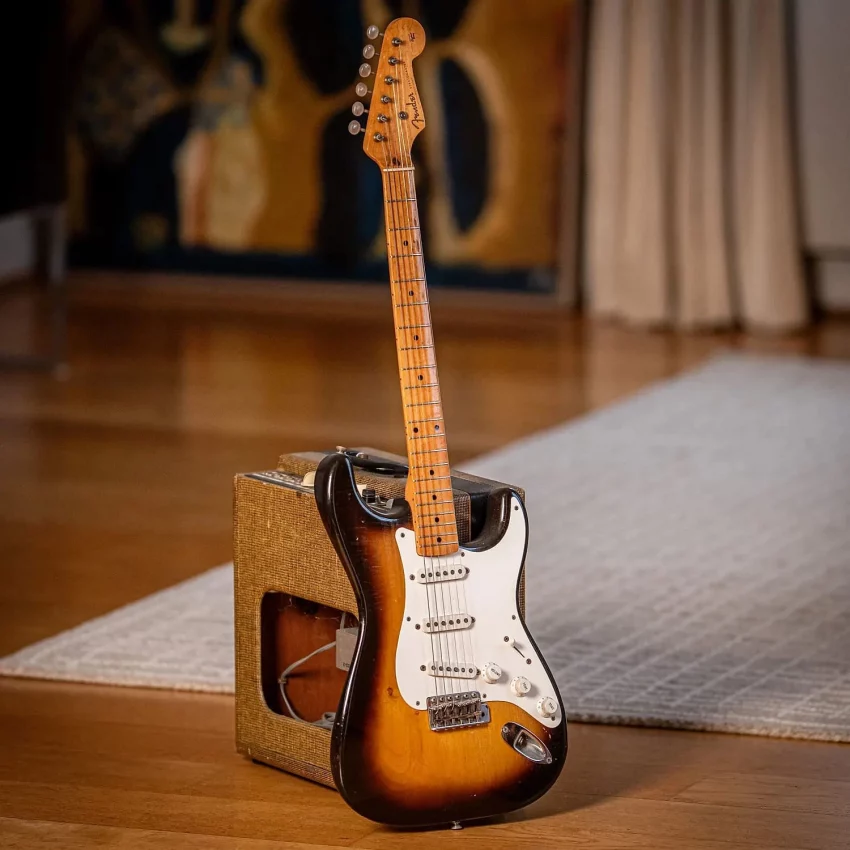
Body: Deeply contoured, solid Ash.
-
Finish: Two-tone sunburst (a basic “one-burst” dark brown edge over natural wood).
-
Neck & Fingerboard: One-piece maple neck with a thick, rounded “D” profile, a 7.25″ radius, and 21 incredibly narrow, small (.078″ wide) frets.
-
Hardware & Electronics: Three Alnico III single-coil pickups, solid brass shaft 100k control pots, a 3-way pickup selector, and an innovative synchronized tremolo system utilizing an incredibly sharp bend in the arm.
Chronological Refinements: A Decade of Micro-Shifts
Leo Fender treated the Stratocaster as a living document. Over the next eleven years, the guitar underwent a continuous stream of ergonomic, aesthetic, and electronic transformations.
1954–1955: Fixing the Beta Version
-
Electronics Update (May/June 1954): The initial 100k potentiometers proved too dark. Fender quickly swapped them for 250k pots, instantly uncovering the bright, bell-like chime the Strat is famous for. The shafts were changed to a split-design to accommodate press-on knobs.
-
The Sunburst & Construction: The finish evolved into a proper two-color spray (canary yellow to amber brown). The one-piece maple neck received a walnut “skunk stripe” to seal the rear-installed truss rod channel.
-
Hardware Refinements (1955): Headstock edges became crisper and less rounded, while the severe bend of the tremolo arm was relaxed for better playing ergonomics.
1956–1957: The Wood and the “V” Necks
-
The Great Wood Swap (1956): In a massive shift, alder replaced ash as the standard body wood (except for transparent blond finishes). While driven primarily by the fact that alder was cheaper and more readily available, it fundamentally altered the guitar’s acoustic profile, trading the scooped clarity of ash for a punchier upper-midrange focus.
-
The Neck Morph (1956–1957): The stocky “D” neck gave way to a soft “V” in 1956, which sharpened into a distinct, strong “V” shape by 1957. This ’57 neck profile remains one of the most celebrated shapes in guitar history, famously anchoring Eric Clapton’s “Blackie” Strat.
-
Component Upgrades: Stronger Alnico V magnets became standard for the pickups, and durable ABS plastic replaced the fragile, brittle Bakelite used for pickup covers and knobs.
1958–1961: The Rosewood Revolution
-
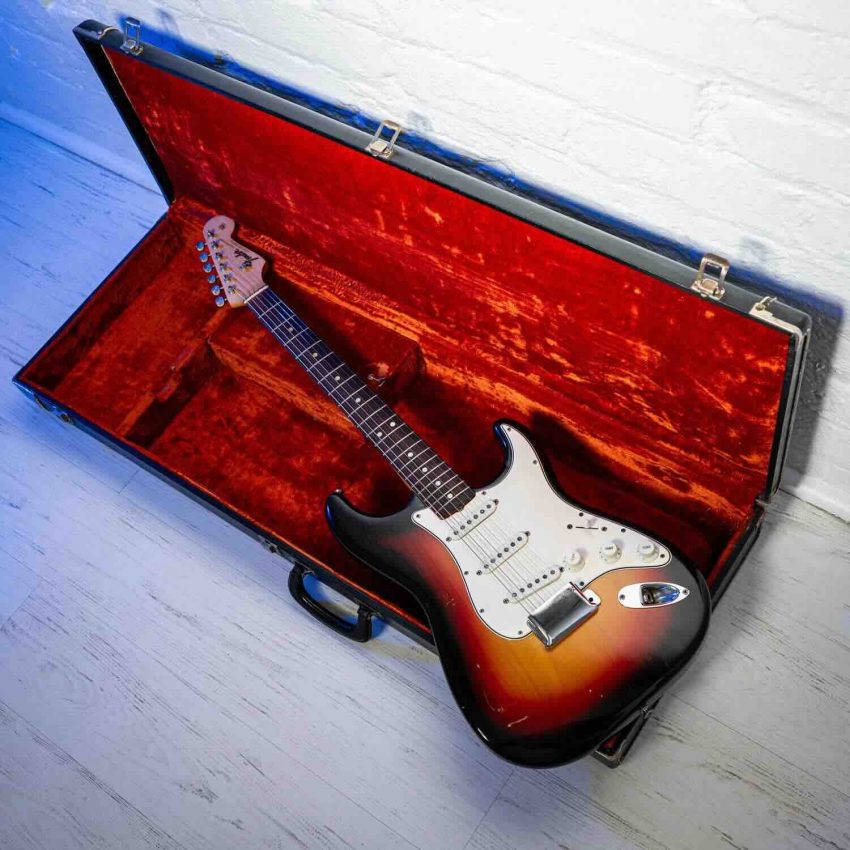
A Splash of Color (1958): Fender introduced the three-tone sunburst, adding a vibrant red dye between the yellow and dark brown rings. The neck profile thinned out significantly into a slim “C.”
-
The Rosewood Fingerboard (1959): To give the guitar a sleeker, more premium look that could compete with Gibson’s aesthetics, Fender abandoned the one-piece maple neck in favor of a two-piece construction featuring a thick “slab” rosewood fingerboard. This significantly warmed up the instrument’s attack.
-
The “Mint Green” Guard: To combat the warping of single-layer plastic, a 3-layer celluloid pickguard with 11 securing screws was introduced. Over time, these guards naturally oxidized into a distinct mint-green hue.
-
Fading Fixes (1961): The red dye used in the 3-tone sunburst was notoriously prone to fading under UV light. In 1961, Fender formulated a much more robust red formulation and swapped the outer brown edge for a starker black.
1962–1965: The Pre-CBS Pinnacle and Transition
-
Veneer Over Slab (1962): Around August, Fender moved away from the thick slab fingerboard, opting instead for a thin, round-laminate rosewood veneer. Concurrently, pickups began receiving additional wire winds, resulting in a hotter, fatter output.
-
Flattening Out (1963–1964): The body contours became noticeably less dramatic, particularly where the player’s right forearm rests. By late ’64, the celluloid mint-green pickguard was retired in favor of a modern, non-fading white 3-layer plastic guard.
-
The Corporate Horizon (1965): On January 5, 1965, Leo Fender sold the company to CBS for $13 million. By December of that year, the headstock profile was enlarged to accommodate a bolder, more prominent brand logo, officially marking the end of the original pre-CBS evolutionary era.
Year-by-Year Specifications Matrix
| Year | Body Wood | Finish Style | Neck Profile | Fretboard | Pickup Magnet | Pickguard Type |
| 1954 | Ash | 2-Tone Sunburst | Rounded D | Maple (1-piece) | Alnico III | 1-Layer White ABS (8-Screw) |
| 1955 | Ash | 2-Tone Sunburst | Rounded D | Maple (1-piece) | Alnico III | 1-Layer White ABS (8-Screw) |
| 1956 | Alder | 2-Tone Sunburst | Soft V | Maple (1-piece) | Alnico V | 1-Layer White ABS (8-Screw) |
| 1957 | Alder | 2-Tone Sunburst | Strong V | Maple (1-piece) | Alnico V | 1-Layer White ABS (8-Screw) |
| 1958 | Alder | 3-Tone Sunburst | Slim C | Maple (1-piece) | Alnico V | 1-Layer White Plastic (8-Screw) |
| 1959 | Alder | 3-Tone Sunburst | Slim C | Rosewood (Slab) | Alnico V | 3-Layer Mint Green (11-Screw) |
| 1960 | Alder | 3-Tone Sunburst | Slim C | Rosewood (Slab) | Alnico V | 3-Layer Mint Green (11-Screw) |
| 1961 | Alder | 3-Tone Sunburst | Slim C | Rosewood (Slab) | Alnico V | 3-Layer Mint Green (11-Screw) |
| 1962 | Alder | 3-Tone Sunburst | Slim C | Rosewood (Veneer) | Alnico V | 3-Layer Mint Green (11-Screw) |
| 1963 | Alder | 3-Tone Sunburst | Oval C | Rosewood (Veneer) | Alnico V | 3-Layer Mint Green (11-Screw) |
| 1964 | Alder | 3-Tone Sunburst | Oval C | Rosewood (Veneer) | Alnico V | 3-Layer White Plastic (11-Screw) |
| 1965 | Alder | 3-Tone Sunburst | Oval C | Rosewood or Maple | Alnico V | 3-Layer White Plastic (11-Screw) |

Head-to-Head: The Great Era Confrontations
For modern players looking at vintage instruments or high-end reissues, the pre-CBS golden era fundamentally breaks down into two distinct flavors of guitar.
The Mid-’50s Maple Blueprint (1954–1957) vs. The Early-’60s Rosewood Workhorse (1959–1962)
| Mid-’50s Maple Blueprint | Early-’60s Rosewood Workhorse |
|
• Tonally bright, percussive, and highly articulate.
• Scooped mids with immediate, glassy treble response.
• Physical, substantial neck profiles (Soft/Strong V). |
• Tonally warm, smoky, and mid-forward with a smoother attack.
• Compressed highs that clip beautifully into overdriven amps.
• Fast, slim, and highly intuitive “C” neck shapes. |
-
The Mid-’50s Experience: This configuration is all about acoustic resonance, snap, and transparency. The one-piece maple neck paired with an ash or early alder body offers an immediate transient response. It “pops” out of a full band mix with pristine clarity. It is the definitive country, funk, and clean-blues machine.
-
The Early-’60s Experience: The introduction of the rosewood board acts as a subtle high-frequency filter, taming the harsh, ice-pick frequencies inherent to single-coil pickups. Combined with the hotter pickup winds of the early ’60s, these guitars deliver a meaty, vocal sustain. This is the tonal foundation for heavy blues-rock, expressive string bends, and texturally rich classic rock.
The Vintage Reality Check: The Human Factor
Among seasoned vintage collectors, it is widely acknowledged that two seemingly identical Stratocasters built in the exact same month can play and sound entirely different. One might be a legendary “holy grail” instrument, while the other is completely uninspiring.
Before the advent of hyper-precise, computer-controlled manufacturing, the Fender factory relied entirely on human hands operating manual machinery.
-
Hand-Wound Variances: Pickup magnets were loaded and coils were wound by eye and feel. A worker who was distracted, tired, or rushing could introduce subtle inconsistencies in the tension and number of coil winds, drastically shifting a pickup’s output and frequency response.
-
Sanding Deviations: Neck profiles and fingerboard radii were hand-shaped on belt sanders. While the spec sheet called for a 7.25″ radius, an individual neck could easily leave the factory measuring closer to 6.75″ or 7.75″ based purely on the operator’s technique that day.
-
Inventory Jugglery: Under the operational management of Forrest White, the factory frequently mixed and matched older parts inventory with updated components to avoid waste. Transitions were fluid, creating hybrid instruments that defied catalog specifications.
The Verdict: What Is the Ultimate Pre-CBS Year?
The Winner: 1962
Among historians, collectors, and players, 1962 stands as the definitive pinnacle of the Stratocaster’s evolution.
By 1962, the Stratocaster had shed its experimental awkwardness without losing its hand-crafted soul. The manufacturing team had spent nearly eight years optimizing assembly methods, resulting in exceptional build consistency.
Sonically and ergonomically, the late-1962 transition from the thick slab board to the thin rosewood veneer paired with a slim “C” neck created an absolute masterpiece. It offered the perfect marriage of maple-neck stability and rosewood warmth, while the slightly hotter pickup winds of that year gave the guitar an incredibly expressive, vocal midrange. It is the most balanced, versatile, and musically intuitive iteration of the pre-CBS era.
The Runners-Up
-
1957: For players who demand a pure, bright single-coil snap and physical tactile feedback, a 1957 spec is the ultimate choice. The combination of the solid alder body, Alnico V magnets, and the legendary, ergonomic strong “V” neck provides a unique, highly expressive playing experience.
-
1954: The ultimate historic artifact. While it lacks the refined electronics and sleeker neck profiles of later years, a true ’54 configuration delivers an unmatched raw, acoustic bell-like chime that remains a benchmark for purists.


#Leo Fender #Fender Stratocaster
This article may contain affiliate links to Andertons, DeathCloud, Donner, Fender, Gear4Music, Guitar Center, Positive Grid, Stew Mac, Sweetwater, and Thomann that help finance the running costs of GuitarBomb. We will receive a small commission if you buy something through these links. Don’t worry; you pay the same price, and it costs you no extra to use these affiliate links for your purchases.


