
Fender Vintera III Series: Updated Period Correctness with Unprecedented Historical Accuracy
Fender Vintera III redefines vintage-inspired guitars with era-specific snapshots and total historical accuracy. Explore the new Stratocaster, Telecaster, and bass lineup.

Fender has officially pulled the curtain back on its Vintera III collection, signaling a fundamental shift in how the iconic brand approaches its most popular vintage-spec instruments. This isn't a minor refresh or a simple paint job. Instead, the company has overhauled the series to move away from the broad "one-size-fits-all" decade categories of the past. Since the line first debuted in 2019, the goal was always to blend the old-school feel with modern playability. However, this newest iteration represents a massive leap toward true historical fidelity, arriving just three years after the well-received Vintera II launch.
The Move Toward Specific Historical Snapshots
The most striking change in the Vintera III lineup is the departure from general decade-based labels. Fender is now drilling down into specific moments in time to capture the nuances that collectors and enthusiasts have long requested.
Instead of a generic 1960s Stratocaster, the new ethos focuses on time-capsule snapshots that represent the evolution of these instruments within those decades.
This granular approach ensures players get a more authentic representation of how these guitars actually felt and sounded as they rolled off the factory floor in Fullerton decades ago.

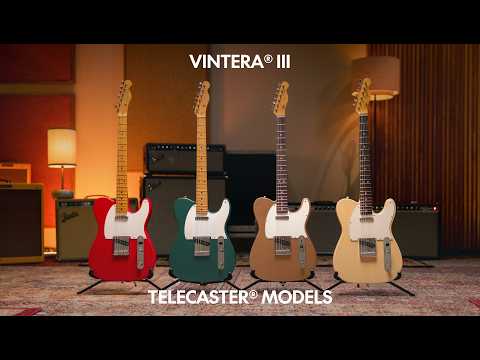
This comprehensive strategy has resulted in a staggering variety of models. The Stratocaster selection alone now features four distinct versions, including the Late 50s Strat, the Early 60s Strat, and the Late 60s Strat. The Telecaster family follows a similar logic, offering a Late 50s Telecaster and a Mid 60s Telecaster, alongside a highly anticipated limited edition Early 60s Custom Telecaster.

A Deep Dive Into the Specs and Hardware
Fender has gone to great lengths to ensure that "vintage accuracy" is more than just a marketing buzzword. The attention to detail is evident in the physical specifications of each model. For instance, the Late 1960s models feature the iconic oversized headstocks that became a hallmark of that era, while the fretboard choices remain period-correct: maple for the 50s iterations and rosewood for the 60s models.

The neck profiles have also been tailored to match their respective eras. Players can expect the thicker V and D shapes on the 50s models, transitioning to the medium C shapes of the early 60s, and then to the slimmer, faster C shapes found on later versions. Beyond the feel of the wood, Fender has utilized its extensive archives to develop specially designed Alnico V pickups. These are voiced specifically to match the tonal characteristics of each distinct snapshot, ensuring that a Mid-60s Jazzmaster sounds exactly like its historical counterpart.

Expanding the Offset and Bass Lineups
The overhaul extends well beyond the flagship models. Offset enthusiasts can choose from Mid 60s Jazzmasters, Jaguars, and Mustangs, all featuring the era-appropriate inlays, decals, and finishes that define those instruments.
The bass category has received an equally impressive expansion. The Vintera III series includes both Early 60s and Early 70s Jazz Basses, a Late 60s Precision Bass, and a continuation of the momentum from the previous series with an Early 60s Bass VI.

Fender leadership has made it clear that the goal of this series was to capture the specific, defining moments that shaped the company’s legacy. By focusing on the most iconic specifications that musicians still seek out today, the brand is providing an authentic connection to the instruments that defined modern music history.

Verdict
While the increased focus on detail comes with a slightly higher price point—with many models retailing for **$1249,**compared to the $1149 of the previous generation—the Vintera III series sets a new benchmark.
It offers a level of historical accuracy previously reserved for much more expensive custom shop or American-made vintage reissues, making high-level accuracy more accessible to the modern performer.
Available at Andertons
Available at Fender
Available at Guitar Center
Available at Sweetwater
Available at Thomann



#Vintera III #Fender
