

Gibson has officially expanded its prestigious Historic Reissue Collection by bringing back one of its most revered golden-era classics. After an eight-year production hiatus, the Gibson Custom 1959 ES-330 Reissue is making a triumphant return. Painstakingly built by the artisans at the Gibson Custom Shop in Nashville, this electric thinline guitar meticulously adheres to the exact specifications of the original 1959 model, offering purists an ultra-authentic vintage experience.
A Masterclass in Vintage Construction
While it shares a nearly identical silhouette with its famous sibling, the ES-335, and its close relative, the Epiphone Casino, the ES-330 stands out due to one defining structural trait: it is a true, fully hollow-body instrument.
By forgoing a heavy maple center block, Gibson has engineered an incredibly lightweight guitar that delivers a remarkably resonant, open, and acoustic-like acoustic response.
The thinline body features a premium three-ply laminate construction of maple, poplar, and maple, complete with historically accurate top binding, dual f-holes, and a classic three-ply pickguard.
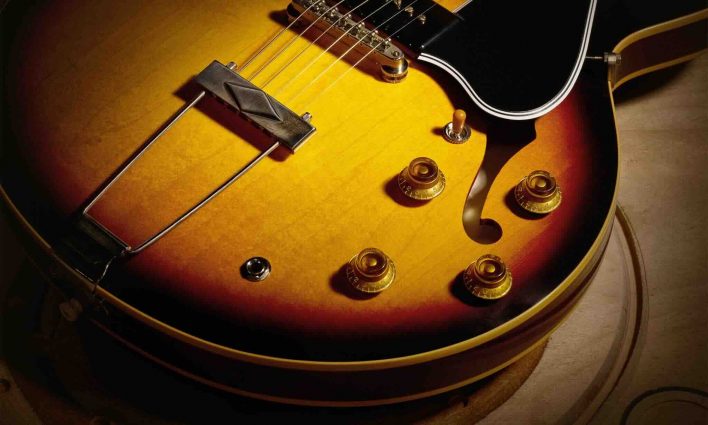
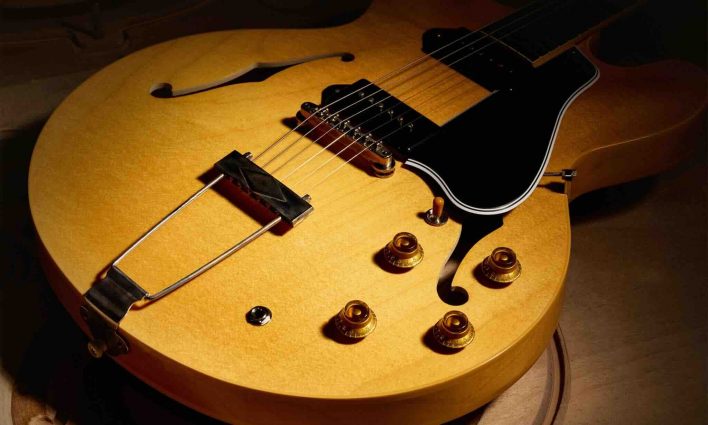
Collectors and players can choose between two stunning, vintage-correct VOS (Vintage Original Spec) aged nitrocellulose lacquer finishes: Vintage Burst and Vintage Natural.
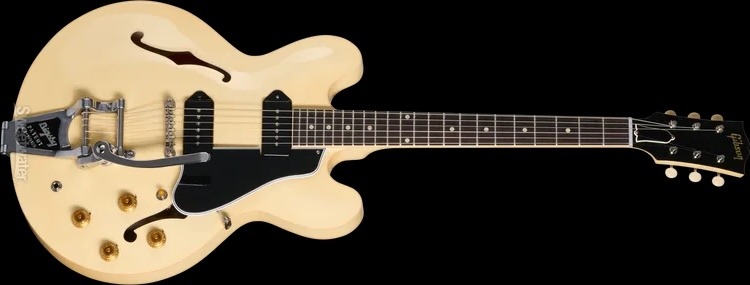
Along with a limited run in Antique White VOS with a Bigsby vibrato.


Period Correct Features
The neck is crafted from solid mahogany with a substantial, period-correct rounded-C profile. It is paired with a bound rosewood fingerboard featuring a 12-inch radius, 22 frets, classic dot inlays, and a nylon nut.
True to the original 1959 specification, the neck-body joint is located at the 16th fret. While this restricts effortless access to the highest register compared to later long-neck iterations, it crucially anchors the bridge in its historically accurate position, maximizing the guitar’s unique tonal transfer.
Rounding out the hardware is a nickel-finished ABR-1 Tune-O-Matic bridge with a trapezoid tailpiece, alongside Kluson Deluxe tuners fitted.
Tailored Electronics and Tonal Character
To capture the distinct voice of the late 50s, Gibson has equipped the reissue with two specially matched, black Dogear P-90 pickups. The bridge pickup utilizes an Alnico 3 magnet to provide bite and clarity, while the neck pickup deploys an Alnico 5 magnet with a slightly lower number of windings to prevent muddiness and maintain exceptional string definition.
The control assembly relies on a traditional Gibson layout with independent volume and tone controls for each pickup, a 3-way toggle switch, premium CTS potentiometers, and paper-in-oil capacitors.
Because of its completely hollow design, the ES-330 is inherently prone to feedback under high-gain conditions, making it poorly suited for modern hard rock or metal.
However, the instrument truly thrives in genres like Americana, blues, country, jazz, and sixties pop. When paired with a clean or slightly overdriven tube amplifier, the ES-330 yields a beautifully singing, dynamic, and touch-sensitive tone.
Pricing and Availability
The Gibson Custom 1959 ES-330 Reissue is available now through authorized Gibson dealers, including Thomann. The retail price is set at €5,799, which includes a premium, period-correct Lifton hardshell case.
Where To Buy
Available at Thomann in Vintage Burst and Vintage Natural at €5799 each
Available at Sweetwater in Antique White with Bigsby at $6999
The History of the Gibson ES-330
First introduced in 1959, the Gibson ES-330 was launched as a more affordable, fully hollow alternative to the semi-hollow ES-335, ES-345, and ES-355 models. Despite its lower introductory price point, its lightweight frame and aggressive P-90 bark quickly made it a favorite among working musicians.
Collectors highly covet the 1959 model because it represents the “short-neck” era of the guitar, where the neck joined the body at the 16th fret. I
n subsequent years, Gibson modified the design to a 19th-fret joint to improve upper-fret access, structurally altering the guitar’s acoustic resonance.
The ES-330’s DNA is famously intertwined with rock history; its sibling design, the Epiphone Casino, became the primary sonic weapon for John Lennon, George Harrison, and Paul McCartney during the peak of The Beatles’ studio era.
Frequently Asked Questions (FAQ)
What is the main difference between the Gibson ES-330 and the ES-335?
The primary difference is internal construction. The ES-335 is a semi-hollow guitar featuring a solid maple center block running down the middle of the body to eliminate feedback and increase sustain, usually paired with humbuckers. The ES-330 is completely hollow inside, making it lighter and more acoustically resonant, and it features single-coil P-90 pickups.
Why does the neck join the body at the 16th fret?
This is a defining feature of the original 1959 specification. While it makes reaching the 17th through 22nd frets more difficult, it shifts the bridge further down the body. This specific bridge placement alters the string tension and body resonance, giving the 1959 reissue its distinctively warm, acoustic character.
Can the Gibson ES-330 handle distortion?
The ES-330 excels at light-to-moderate overdrive, offering a highly expressive, singing quality. However, because it lacks a center block, it will easily feedback at high volumes or when paired with high-gain distortion and fuzz pedals.
Verdict
The Gibson Custom 1959 ES-330 Reissue is an absolute triumph of historical accuracy.
While its $ 6,999/€5,799 price tag places it firmly in the luxury/collector tier, the flawless VOS ageing, exceptionally matched P-90 pickups, and lightweight acoustic resonance justify the investment for tone purists.
It isn’t a do-it-all machine—high-gain players should look elsewhere—but for blues, jazz, and vintage rock, it offers an uncompromised portal back to 1959.
Score
-
Build Quality & Authenticity: 9.8/10
-
Tone & Resonance: 9.6/10
-
Playability: 8.5/10 (Historical 16th-fret joint limits upper access)
-
Value for Money: 8.0/10
Overall Score: 8.7 / 10
#Gibson #1959 ES-330 Reissue
This article may contain affiliate links to Andertons, DeathCloud, Donner, Fender, Gear4Music, Guitar Center, Positive Grid, Stew Mac, Sweetwater, and Thomann that help finance the running costs of GuitarBomb. We will receive a small commission if you buy something through these links. Don’t worry; you pay the same price, and it costs you no extra to use these affiliate links for your purchases.


