

In a move that is sending shockwaves through the luthier community and vintage purists alike, Gibson Brands, Inc. announced this morning the successful acquisition of Sentient Polymer Solutions, a leader in high-density recycled materials. The partnership marks the beginning of “Project Neptune,” a radical shift in guitar manufacturing that will see the iconic Les Paul and SG Standard lines move away from traditional mahogany in favor of a proprietary material: Hydro-Core™.
The Death of Tonewood?
For decades, the “tonewood debate” has centered on the resonance of old-growth mahogany and the sustain of rosewood. However, as CITES regulations tighten and the global supply of premium resonant woods dwindles, Gibson’s R&D team has spent three years developing a “molecularly superior” alternative.
Last year, we wrote about Super Wood by InventWood, which uses heat and pressure to strengthen standard wood. Now it seems Gibson has turned to other alternative eco materials for mass-produced guitars.
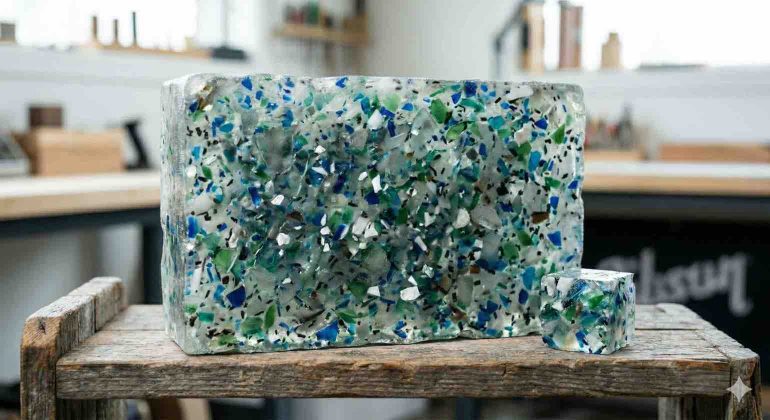
Hydro-Core™ is a high-pressure composite harvested entirely from authentic recycled ocean-bound plastics and reinforced with micro-particulate carbon fibers. According to Gibson’s Chief Product Officer, the material isn’t just a sustainable substitute—it’s an upgrade.
“Wood is organic, which means it’s inconsistent,” the press release stated. “Hydro-Core™ allows us to tune the density of the guitar body at a molecular level. We’ve achieved a sustain coefficient that is 14% higher than 1950s-era Honduran Mahogany.”
A New Aesthetic
The transition will begin with the “Neptune Series,” featuring a translucent “Sea-Glass” nitrocellulose finish. While the classic gold tops and bursts will remain available, early leaked mockup images suggest that the recycled material may yield unique “particulate bursts,” in which tiny fragments of recycled ocean debris are visible through the finish.
The Market Reaction
Initial reactions on forums like The Gear Page and Reddit have been predictably explosive. While some applaud the move toward environmental consciousness, others are skeptical of the “Plastic Paul.”
“If it doesn’t have grain, it doesn’t have soul,” wrote one prominent collector. However, with several high-profile artists reportedly already touring with Hydro-Core™ prototypes, the industry may have no choice but to adapt to the “New Wave” of tone.
Technical Specifications: Hydro-Core™ vs. Old-Growth Mahogany
Gibson released the following benchmark data to appease the spec-heads and tone-chasers. The results suggest that the “plastic” guitar might actually outperform the “lumber” legends.
| Metric | 1959 “Burst” Mahogany | Hydro-Core™ Composite |
| Density Consistency | 74% (Variable Grain) | 99.8% (Molecularly Uniform) |
| Sustain Decay (sec) | 12.4s | 14.2s |
| Resonant Frequency | 440Hz – 1.2kHz | 440Hz – 5.8kHz (Extended Highs) |
| Moisture Absorption | 8.2% (Warps over time) | 0.0% (Hydrophobic) |
| Weight | 8.5 lbs – 10 lbs | Fixed 8.2 lbs |
The Artist Perspective
We reached out to a few industry titans for their take on the transition. While most are staying quiet until the official NAMM launch, one legendary blues-rocker (who requested anonymity due to his current signature wood-body contract) gave us this puzzling endorsement:
“I’ve been A/B testing the Neptune prototype in the studio for three weeks. I hate to say it, but the ‘ocean-plastic’ SG has a certain… ‘fluidity’ to the low-end that my mahogany guitars lack. It’s got a salt-of-the-earth grit, literally. If you told me it was made of recycled detergent bottles, I wouldn’t care—it sounds like God’s own doorbell.”
Availability
The first run of Project Neptune Les Pauls is slated for a pre-order launch on April 1st. Pricing is expected to start at $7,999, a premium price point that Gibson justifies by the “high cost of ethical ocean harvesting.” We will update you as soon as the new line is available.
More Information
#Gibson #Project Neptune
This article may contain affiliate links to Andertons, DeathCloud, Donner, Fender, Gear4Music, Positive Grid, Stew Mac, Sweetwater, and Thomann that help finance the running costs of GuitarBomb. We will receive a small commission if you buy something through these links. Don’t worry; you pay the same price, and it costs you no extra to use these affiliate links for your purchases.


2 thoughts on “Gibson Announces “Project Neptune,” Pivoting to Ocean-Bound Plastic Composites for Standard Line”
When will these be online? As I want to order the Les Paul.
If this is and April fools prank then is appropriate. If it’s not then you picked the wrong data post it