

Is this the most versatile silicon fuzz on the market? We dive into the “King in Yellow” to find out.
In the world of guitar effects, terms like “modern classic” are thrown around loosely. However, the DOD Carcosa Fuzz has earned that title. While it may have been born of the fuzz boom of the 1970s, it has cemented its place on pedalboards around the world as a contemporary powerhouse.
With its interactive controls and the terrifying visage of the King in Yellow staring back at you, this pedal invites you to explore the nooks and crannies of lost Carcosa. From Black Sabbath riffage to desiccated, gated shards of noise, this is our Pedal of the Week.
A Silicon Circuit with Ancient Roots
Every week, I’ll feature one of my stompboxes, share some history and background, and explain why it should be on your radar. For our first installment, I had to go with this modern classic, which I adore and has more going on than the average fuzz pedal, and all without a ridiculous high price point and boutique exclusivity!
To understand this pedal, we have to look at the preternatural origins of Carcosa, an ancient, mysterious city that is home to The King in Yellow, the bringer of madness and doom in Robert W. Chambers’ 1895 book.
Madness and doom. Now we’re getting somewhere.
The Carcosa is rooted firmly in the fuzz boom of the ’70s, drawing inspiration from the hallowed Maestro FZ1-S Fuzz Tone.
It features a silicon circuit that provides incredible mid-range clarity and attack. Unlike many vintage units that get lost in a band mix, the Carcosa is designed to have an exaggerated mid-range and treble character. It cuts through a dense mix while maintaining great note articulation, even with chords.
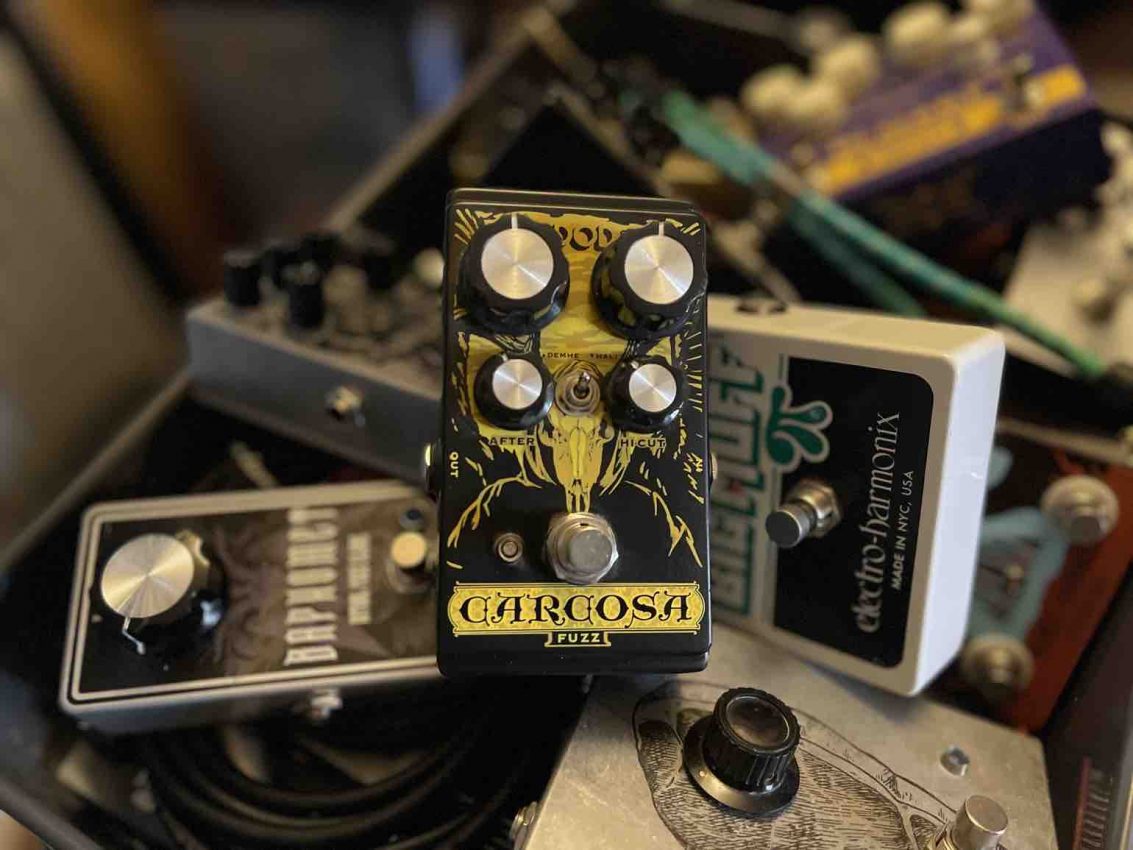
Mastering the Chaos: The Controls
The magic of the Carcosa lies in the dynamic interplay of its controls. It is certainly not a one-trick pony.
Before & After: The Bias Game
-
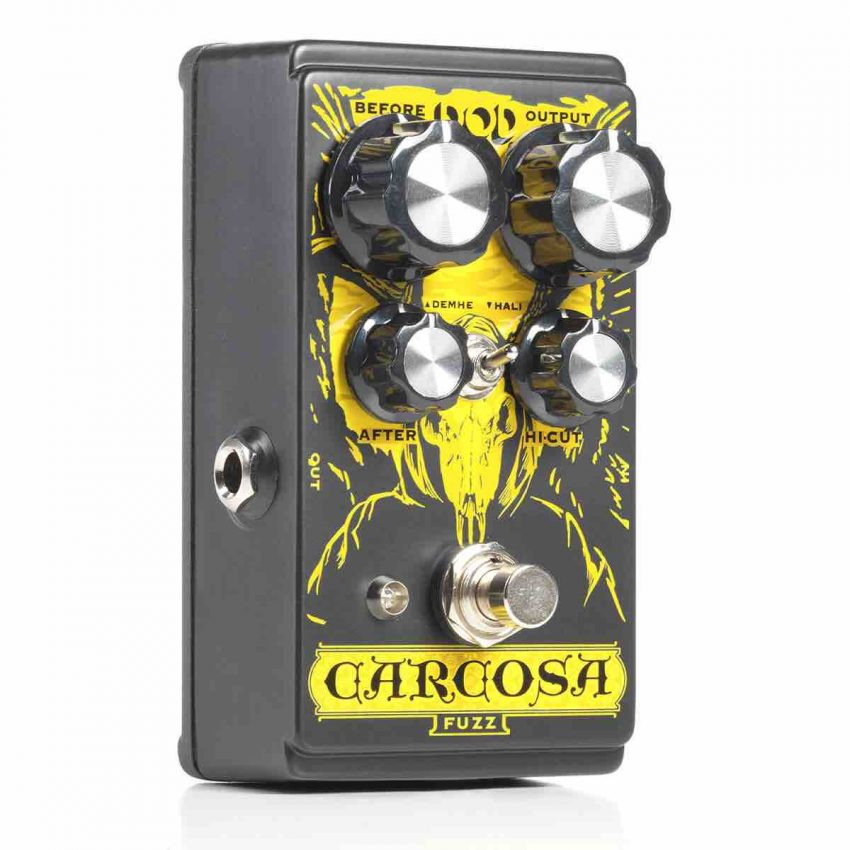
BEFORE: This is your standard fuzz control. Roll it right for wall-of-sound fuzz, left for less. It has a decidedly vintage character. If you are a player who likes to ride the volume knob on your guitar, the Carcosa cleans up beautifully from full-tilt chaos to a meaty overdrive.
-
AFTER: This is the key to the pedal. This bias control allows you to toggle between tame, pokey fuzz tones and wild, over-the-top sounds. Crank it to change the texture from a smooth sustain to splatty, gated textures.
Pro Tip: Try the “After” control fully cranked with the “Before” knob set to about 9:00. This delivers a fantastic gated overdrive tone—a true “sound in my head” moment.
The Toggle Switch: Demhe vs. Hali
DOD has solved the age-old problem of fuzz pedals reacting poorly to different amps. The toggle switch optimizes the pedal for your specific setup:
-
Hali Mode (Up): Best for dirty amps. This applies a light, tight-sounding fuzz with a bass cut to prevent mud. It ensures ‘definition’ for solos when running into a hot amp.
-
Demhe Mode (Down): Best for clean amps. This mode adds a low-end and mid-range bump, creating that “porcine fatness” that fills out a clean channel.
(Fun fact: In the lore, Carcosa sits on the shore of a misty lake called Hali. Demhe, also a lake, acts as a mirror image to Hali.)
Hi-Cut
To tame the bright silicon character, the Hi-Cut knob gives you full reign over high-frequency details. Whether you want to act as a treble booster or smooth out the top end, this control adapts to where your bias knobs are set.
FAQ: DOD Carcosa Fuzz
Q: Is the DOD Carcosa true bypass?
A: Yes, the Carcosa features true bypass switching, ensuring your tone remains unaffected when the pedal is off.
Q: Can the Carcosa do “velcro” or gated fuzz sounds?
A: Absolutely. By turning the After (bias) knob up, you can achieve splatty, broken-speaker, and gated fuzz tones.
Q: Does it work better with single coils or humbuckers?
A: It works great with both thanks to the Hi-Cut and Input interactions. However, the mid-range character helps it stand out particularly well with humbuckers that might otherwise get muddy.
Q: What is the difference between the Demhe and Hali modes?
A: Demhe boosts bass and mids (great for clean amps), while Hali cuts bass for a tighter sound (great for already overdriven amps).
Tom Cram – The Legend
The mastermind behind the DOD Carcosa Fuzz is Tom Cram, a legendary figure in the pedal industry and the former head of product development at DigiTech/DOD. An avowed “fuzz nerd,” Cram’s journey with the Carcosa began at a trade show where he encountered a dead-mint Maestro FZ1-S.
While he couldn’t afford the rare unit at the time, the encounter sparked an obsession. He eventually found a more affordable, beat-up version and began working on an unnamed DOD project to reimagine that classic 1970s silicon circuit for the modern era.
The design process was a year-long labor of love alongside engineer Parker Coons. Cram wasn’t satisfied with a simple clone; he wanted to push the circuit into “Iteration Land,” adding a clipping stage, power filtering, and the signature “After” bias control that allows the pedal to move from smooth vintage fuzz to “shattered Pollock abstractions.”
Even the pedal’s unique visual identity was personal—Cram has noted that the graphic of the King in Yellow came to him in a dream, which he quickly sketched on a 3×5 card before handing it to a graphic designer to finalize.
Beyond the electronics, Cram’s literary interests heavily influenced the pedal’s DNA. He was deeply immersed in the cosmic horror of Robert W. Chambers and Ambrose Bierce during the design phase, leading him to name the pedal “Carcosa” and its modes “Demhe” and “Hali.”
Following his tenure at DOD, Cram founded Spiral Electric FX, where he continues to hand-build boutique pedals that carry on the spirit of innovation and “fuzzy madness” he brought to the Carcosa.
Our Thoughts: The Verdict
The DOD Carcosa Fuzz is a doorway into an alternate fuzz universe. It successfully bridges the gap between classic tones of legend and splattered, shattered abstract noise.
What I love most is the versatility. It can serve as a bright, dirty boost, a classic 70s rock machine, or a modern experimental noise generator. The “After” bias control is the MVP here, allowing you to sculpt textures that range from smooth to “desiccated shards.”
If you need a fuzz that cuts through the mix and offers endless exploration without breaking the bank, the Carcosa is a modern classic for a reason.
Score: 5/5
Where to Buy
You can find the DOD Carcosa Fuzz at major music retailers and directly through the manufacturer.
-
Official Site: DigiTech / DOD


More Information
#DOD #Carcosa #Fuzz Pedal #Pedal of the Week
This article may contain affiliate links to Andertons, DeathCloud, Donner, Fender, Gear4Music, Positive Grid, Sweetwater, and Thomann that help finance the running costs of GuitarBomb. We will receive a small commission if you buy something through these links. Don’t worry; you pay the same price, and it costs you no extra to use these affiliate links for your purchases.


