Easy Guitar Lesson: Unlock a Decade of Guitar Secrets in 10 Minutes
Easy Guitar Lesson: Guitar Pro Tips: A 10-Minute Masterclass - Discover the secrets to playing smooth solos, & crafting captivating melodies

Do you like Easy Guitar Lessons? Are you tired of mindlessly noodling up and down the fretboard? Ready to elevate your guitar playing to the next level? Let's dive into the world of the pentatonic scale, a fundamental tool for guitarists of all skill levels.
Easy Guitar Lesson -What is a Pentatonic Scale?
In this Easy Guitar Lesson, we will use the beginner-friendly pentatonic scale*,* which has five notes per octave.
Unlike major or minor scales, pentatonic scales are more straightforward, making them easier to learn and play. They're widely used in various musical genres, from blues and rock to jazz and metal.
The A Minor Pentatonic Scale: A Beginner's Friend
The A minor pentatonic scale is a fantastic starting point for beginners, making it perfect for this easy guitar lesson. It's easy to learn and sounds great, making it a popular choice for aspiring guitarists. Here's how to find it on your guitar fretboard:
- Locate the Root Note: Start at the fifth fret of the low E string. This is your A note, the root of the scale.
- Build the Shape: From the root note, move up two frets, then down two strings. Repeat this pattern until you reach the high E string.
- Below, the root notes are marked as red dots.

Tips for Mastering the Pentatonic Scale
- Slow and Steady Wins the Race: Practice slowly and focus on playing each note cleanly.
- Use a Metronome: A metronome will help you develop a strong sense of rhythm and timing.
- Break it Down: Practice the scale in smaller sections to make it less overwhelming.
- Listen to Great Guitarists: Pay attention to how your favorite guitarists use the pentatonic scale.
- Record Yourself: Recording your playing can help you identify areas for improvement.
Don't Just Walk!
Now that we've established scales as essential tools for guitarists let's explore how to use them effectively. The A minor pentatonic scale is often the first one guitarists learn when exploring soloing.
It's a great starting point because it's relatively simple yet versatile.
To recap, the A minor pentatonic scale positions on the guitar are:
- Low E: 5th fret, 8th fret
- A: 5th fret, 7th fret
- D: 5th fret, 7th fret
- G: 5th fret, 7th fret
- B: 5th fret, 8th fret
- High E: 5th fret, 8th fret
Many new guitarists make the mistake of simply "walking" up and down the scale. While this is an excellent way to learn the notes, it doesn't create music. It's more like reciting information than playing a melody.
To truly bring a scale to life, we must identify the root notes (marked in red in our diagrams) and learn how to emphasize them. In the A minor pentatonic scale, there are three root notes (A):
- Low E: 5th fret
- D: 7th fret
- High E: 5th fret
The root note is the foundation of the scale and the key to its tonal identity. To make it musical, we can experiment with different techniques like:
- Hammer-ons and pull-offs: Smoothly connecting notes to create a flowing melody.
- Bends: Adding expression and emotion by bending the pitch of a note.
- Vibrato: Pulsating a note to add warmth and sustain.
Focusing on the root notes and using these techniques can transform a simple scale into a powerful and expressive tool for creating beautiful melodies.
Breaking Down the A Minor Pentatonic Scale
To further explore the A minor pentatonic scale, we'll divide it into three distinct boxes, each centered around one of the root notes. This approach allows us to focus on specific tonal areas and develop more musical phrasing.
Here's how we'll divide the scale:
Box 1 (Low Register):
- Low E: 5th fret, 8th fret
- A: 5th fret, 7th fret

Box 2 (Middle Register):
- D: 5th fret, 7th fret
- G: 5th fret, 7th fret

Box 3 (High Register):
- B: 5th fret, 8th fret
- High E: 5th fret, 8th fret

We can experiment with different melodic ideas and rhythmic patterns within each tonal center by isolating these boxes. The root note in each box acts as a strong anchor, guiding our improvisations and ensuring a cohesive musical expression.
Using a Metronome or a Drum Loop
Use a metronome to practice playing through each box, focusing on the abovementioned musicality and phrasing techniques. You can also try a drum loop to add groove and feel to your playing. Below are three metronomes we recommend, starting from under $10.

Taking Your Pentatonic Playing to the Next Level
Once you've mastered the basic shape of the A minor pentatonic scale, you can start exploring more advanced techniques. Here are a few ideas:
- Experiment with Different Rhythms: Try playing the scale with different rhythms, such as swing, shuffle, or funk.
- Add Bending and Vibrato: Incorporate these techniques to add expression and emotion to your playing.
- Learn Different Scale Positions: Learn the pentatonic scale in different positions on the fretboard to expand your musical vocabulary.
- Combine the Pentatonic Scale with Other Scales: Experiment with combining the pentatonic scale with other scales, such as the major or minor scale.
Guitar Mastery Method Video on the Pentatonic Scale
Below is an excellent video by Guitar Mastery Method on this whole process. They cover this simple concept in under ten minutes. This simple yet effective lesson is a fantastic step in becoming a more confident guitarist who can play with other musicians and create new and exciting guitar lines and memorable solos.
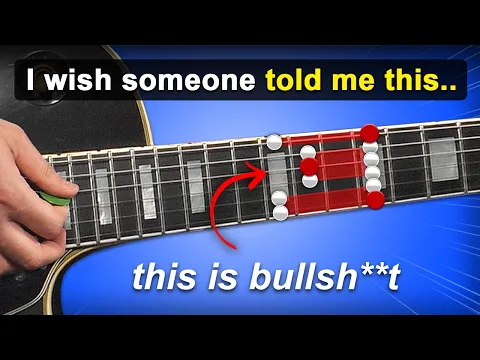
Easy Guitar Lesson - Practice!
Remember, practice makes perfect! The more you practice, the better you'll play the pentatonic scale. So, grab your guitar, start practising, and let your musical journey begin!
More How-To Guides onGuitar Bomb
#Easy Guitar Lesson
What is the pentatonic scale and why should beginners learn it?
The pentatonic scale has five notes per octave, making it simpler than major or minor scales. It's widely used in blues, rock, jazz, and metal, and is perfect for beginners because it's easy to learn yet sounds great when played musically.
Where do I find the A minor pentatonic scale on the guitar?
Start at the 5th fret of the low E string (the root note A). From there, move up two frets, then down two strings, repeating this pattern until you reach the high E string. Root notes are at the 5th fret on low E, 7th fret on D, and 5th fret on high E.
How can I make the pentatonic scale sound musical instead of just walking up and down it?
Focus on the three root notes (A) and use techniques like hammer-ons, pull-offs, bends, and vibrato. Breaking the scale into three boxes and experimenting with different rhythms and phrasing will transform it from a mechanical exercise into expressive music.
What practice tools help master the pentatonic scale?
Use a metronome to develop rhythm and timing, practice slowly focusing on clean notes, break the scale into smaller sections, listen to how great guitarists use pentatonic scales, and record yourself to identify areas for improvement.
Keep browsing

Get this stuff first.
Leaks, deals and reviews in your inbox, once a week. No spam, just gear.