P-90 Pickups: History, Signature Tone & Best Modern Upgrades
Explore P-90 pickup history, design, signature tone, and best modern upgrades. From Walt Fuller's 1946 invention to iconic songs and top picks.

Few components in electric guitar history have shaped the sound of modern music as much as the P-90 guitar pickup. Introduced by Gibson in 1946, this wide-bobbin single-coil design bridges the tonal divide between bright Fender-style single-coils and thick dual-coil humbuckers, delivering a raw, dynamic voice that has powered everything from 1950s jazz and British blues-rock to punk and stadium anthems.
Who Invented the P-90 Pickup? A Brief History
While Seth Lover routinely receives the spotlight for inventing Gibson's PAF humbucker in the late 1950s, the P-90 was the brainchild of Walt Fuller, the long-serving head of Gibson's electronics department.
Gibson's path to the P-90 began in the 1930s with the ES-150 electric archtop and its massive, two-pound cobalt-magnet pickup—forever known as the "Charlie Christian" pickup.
Looking for lighter, more practical alternatives, Gibson experimented with a diagonal "offset adjustable pickup" and Fuller's compact P-13 pickup in 1940. Fuller had already conceptualized a refined single-coil design prior to World War II, but wartime manufacturing shifted Gibson's Kalamazoo factory toward military electrical subcontracts, which Fuller supervised.
As soon as civilian guitar production resumed after the war in 1946, Fuller combined the best structural traits of the shorter diagonal pickup and the P-13 to unveil the P-90. For more than a decade, it served as Gibson's flagship pickup across virtually its entire catalog—from upscale jazz archtops like the ES-5 to the inaugural 1952 Gibson Les Paul Goldtop and the stripped-down Les Paul Junior—until the PAF humbucker arrived in 1957.
The Three Classic P-90 Housing Formats
Over the decades, the P-90 has appeared in three primary physical formats to suit different guitar constructions:
- Soapbar P-90: Named after its rectangular proportions and cream-colored plastic cover on early 1950s Les Pauls, this version mounts directly into the guitar body using two screws positioned inside the coil perimeter between the second and third, and fourth and fifth pole pieces.
- Dogear P-90: Built around the same internal coil and magnet assembly, the Dogear features triangular mounting tabs on either side so it can be screwed straight onto the top of hollow-body and thinline guitars like the Gibson ES-330 and Epiphone Casino, as well as solid-body models like the Les Paul Junior.
- Humbucker-Sized P-90: Designed for modern modders, these drop-in single-coil units house a P-90-style coil and magnet architecture inside a standard humbucker cover, eliminating the need to route wood out of a humbucker-equipped guitar.
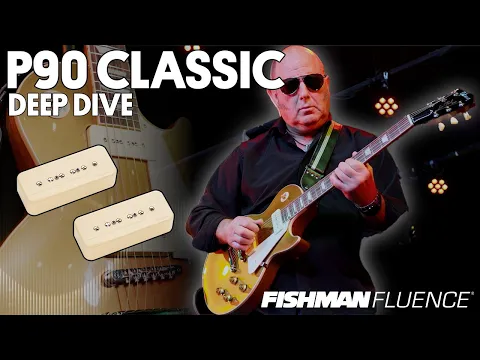
Inside the Design: Why P-90 Pickups Sound So Unique
At its core, a P-90 is a true single-coil pickup. Like a Stratocaster or Telecaster pickup, it uses a single copper coil and is naturally susceptible to 60-cycle AC hum unless paired with a reverse-wound/reverse-polarity (RWRP) companion or hum-canceling circuitry. However, two major engineering choices give the P-90 its unmistakable voice:
- Dual Alnico Bar Magnets: Instead of using six magnetized rod pole pieces like traditional Fender single-coils, a P-90 mounts two full-size Alnico bar magnets horizontally beneath the bobbin. These magnets transfer their magnetic field upward through six adjustable steel pole screws, creating a broader, deeper magnetic aperture beneath the strings. (Early 1950s Gibson P-90s used Alnico 3 magnets before Gibson transitioned to stronger Alnico 5 magnets in 1957.)
- Wide, Shallow Bobbin Geometry: A P-90 bobbin is roughly twice as wide as a standard Fender single-coil bobbin, yet noticeably shorter. Winding 42 AWG plain enamel wire across this wide, flat profile places more copper closer to the pole pieces, raising inductance and producing higher output with a fuller midrange than conventional single-coils.

What Sort of Tones Do P-90 Pickups Offer?
Players often describe the P-90 as the "Goldilocks" pickup—sitting squarely between single-coil sparkle and humbucker muscle.
- Glass-Clear, Punchy Cleans: Because it relies on a single coil rather than two phase-canceling coils, a P-90 retains crisp treble articulation and fast transient attack. Clean chords ring with piano-like separation rather than the thick low-end bloom that can sometimes make humbuckers feel dark.
- Dynamic Touch Sensitivity: P-90s reward expressive picking dynamics. Digging in with a pick pushes a tube amp into immediate harmonic breakup, while rolling back the guitar's volume control cleans up the signal without losing top-end definition.
- Signature Midrange Bark and Snarl: When driven through an overdriven amp or fuzz pedal, P-90s unleash a gritty, vocal midrange growl that slices effortlessly through dense band mixes.
- Bridge vs. Neck Balance: In the bridge position, a P-90 delivers muscular twang, rock crunch, and raw bite. In the neck position, it produces a lush, woody warmth ideal for blues and jazz—though players often lower the neck pickup slightly to keep its substantial low end tight and focused. While ultra-tight modern metal styles with heavily scooped mids usually favor humbuckers, P-90s thrive across blues, jazz, classic rock, indie, garage rock, and punk.

Famous Songs Recorded with P-90 Pickups
Countless landmark guitar tracks owe their unmistakable bite and midrange authority to P-90 pickups:
- "Another Brick in the Wall (Part 2)" – Pink Floyd: David Gilmour tracked his iconic, stinging guitar solo on a 1955 Gibson Les Paul Goldtop equipped with P-90s, running the guitar straight into the studio mixing desk before re-amping it through a Mesa/Boogie Mark I.
- "Mississippi Queen" – Mountain: Leslie West's colossal, snarling riff tone came from a single-pickup Gibson Les Paul Junior armed with a Dogear P-90.
- "Paranoid" – Black Sabbath: Before switching to custom humbuckers later in his career, Tony Iommi forged heavy metal's foundational riffs on early Black Sabbath records using his P-90-loaded Gibson SG Special ("Monkey").
- "Won't Get Fooled Again" – The Who: Pete Townshend relied on a P-90-equipped Gibson SG Special throughout The Who's Tommy, Live at Leeds, and Who's Next era, harnessing its explosive midrange crunch for his signature windmilling power chords.
- "Taxman" & "Ticket to Ride" – The Beatles: John Lennon, Paul McCartney, and George Harrison all adopted P-90-equipped Epiphone Casinos during the mid-1960s, with McCartney using his Casino's P-90s to cut the sharp, biting solos on "Ticket to Ride" and "Taxman".
- "Soul Sacrifice" – Santana: Carlos Santana's singing, vocal sustain on Santana's early studio albums and legendary Woodstock performance came from a P-90-loaded Gibson SG Special.
- "American Idiot" – Green Day: Billie Joe Armstrong's tight, aggressive punk rhythm sound on American Idiot was anchored by his vintage P-90-equipped Gibson Les Paul Junior.
- "Bad to the Bone" – George Thorogood & The Destroyers: George Thorogood's gritty slide and riff work came straight from a hollow-body Gibson ES-125 fitted with a single P-90.
Best Modern-Day P-90 Pickup Equivalents
Whether you want period-accurate 1950s chime, higher-output rock grind, silent stage operation, or a drop-in humbucker replacement, modern pickup winders offer outstanding options across every format:
| Pickup Model | Format | Magnet Type | Best For |
| Gibson P-90 Soapbar / Dogear | Soapbar / Dogear | Alnico V | Authentic factory Gibson tone with wax-potted reliability |
| Seymour Duncan Antiquity P-90 | Soapbar / Dogear | Alnico II | Vintage early-1950s blues warmth, sweet attack, and midrange bark |
| Bare Knuckle Supermassive 90 | Soapbar / Humbucker | Alnico V | High-output modern rock riffs with thick low-mids and clarity |
| Mojotone '56 Quiet Coil P-90 | Soapbar / Dogear | Alnico V | Passive hum-free operation that preserves vintage touch sensitivity |
| Lindy Fralin Hum-Cancelling P-90 | Soapbar / Dogear | Neodymium | Boutique, zero-hum P-90 punch with strong output and articulation |
| Seymour Duncan Phat Cat | Humbucker-sized | Alnico II | Drop-in P-90 bite and sustain for humbucker-routed guitars |
| Lindy Fralin P-90 Humbucker | Humbucker-sized | Alnico V | Snarly midrange and percussive highs without body routing |
Top Picks by Category
- Best Vintage-Spec Replacements: The Seymour Duncan Antiquity P-90 recreates early-1950s specs with twin Alnico II magnets (7.80k neck / 8.60k bridge) for sweet blues bite and hum-canceling middle-position performance. If you prefer the sharper punch of late-1950s pickups, the standard Gibson P-90 (Alnico V, roughly 8k DC resistance) delivers the classic factory voice straight from the originators.
- Best High-Output Option: Hand-wound in the UK, the Bare Knuckle Supermassive 90 pushes Alnico V magnets to a 10.6k wind, offering huge low-end weight and saturation for heavy rock while preserving single-coil note separation.
- Best Noiseless P-90s: Players dealing with noisy stage lighting or high-gain rigs can eliminate 60-cycle hum without sacrificing character using the passive Mojotone '56 Quiet Coil P-90 (Alnico V, 8.6k) or the neodymium-powered Lindy Fralin Hum-Cancelling P-90. For players who want active versatility, the Fishman Fluence Greg Koch Gristle-Tone P-90 provides three selectable voices with silent operation.
- Best Humbucker-Sized P-90s: If your guitar is routed for standard humbuckers, drop-in models like the Seymour Duncan Phat Cat (twin Alnico II magnets), Lindy Fralin P-90 Humbucker, and Lollar Novel 90 deliver unmistakable single-coil bark and clarity with a straightforward solder-in swap.
P-90s are still some of my favorite pickups, and I have them in a lot of my guitars because they offer something no other pickup has.
Eighty years after Walt Fuller finalized the design in Kalamazoo, the P-90 remains proof that great pickup engineering never goes out of style. By combining single-coil clarity with broad, muscular midrange authority, it continues to give guitarists an expressive voice that sits effortlessly in any mix.

- +Bridges the tonal gap between bright single-coils and thick humbuckers
- +Crisp, articulate treble with fast transient attack
- +Rewarding touch sensitivity and dynamic response
- +Signature gritty midrange bark cuts through band mixes
- +Versatile across blues, jazz, rock, indie, garage, and punk
- −Naturally susceptible to 60-cycle AC hum (unless RWRP or hum-canceling variants used)
- −Heavier low-end output requires careful neck pickup voicing to avoid mud
- −Not ideal for ultra-tight modern metal styles with heavily scooped mids
What is a P-90 pickup and how does it differ from other single-coils?
A P-90 is a single-coil pickup using two full-size Alnico bar magnets and a wide, shallow bobbin instead of six magnetized rods. This design produces higher output, fuller midrange, and broader magnetic aperture than traditional Fender single-coils while retaining crisp treble articulation.
Who invented the P-90 pickup?
Walt Fuller, head of Gibson's electronics department, invented the P-90 in 1946 by combining design traits from earlier Gibson pickups. It became Gibson's flagship pickup across its catalog until the PAF humbucker arrived in 1957.
What are the three main P-90 housing formats?
Soapbar (rectangular, mounts flush into solid bodies), Dogear (triangular tabs for hollow-body and thinline guitars), and Humbucker-Sized (drops into standard humbucker cavities without routing). Each houses the same coil and magnet architecture in different mounting styles.
Which famous songs were recorded with P-90 pickups?
Iconic tracks include Pink Floyd's 'Another Brick in the Wall (Part 2),' Black Sabbath's 'Paranoid,' The Who's 'Won't Get Fooled Again,' The Beatles' 'Taxman,' Santana's 'Soul Sacrifice,' and Green Day's 'American Idiot'—all powered by P-90-equipped guitars.
Keep browsing

Get this stuff first.
Leaks, deals and reviews in your inbox, once a week. No spam, just gear.