Coil Split vs. Coil Tap: The Real Difference (And Why Marketing Gets It Wrong)
Coil splitting vs. coil tapping: two different guitar wiring mods explained. Learn the sonic differences and why manufacturers mislabel them.

If you’ve spent any time browsing spec sheets for modern electric guitars, you’ve likely encountered the terms "coil split" and "coil tap." Often, they are presented as synonyms, used interchangeably by manufacturers to signal that the guitar offers "extra" tonal versatility.
If you are a gear nerd, however, you know that the devil is in the details. They are fundamentally different electrical modifications. Using them interchangeably is like calling a tremolo system a vibrato unit—technically incorrect, even if everyone knows what you’re trying to say.
For those of you looking to demystify what’s happening under the hood of your favorite axe, here is the technical breakdown.
Coil Splitting: The Humbucker Hack
Coil splitting is a technique exclusive to humbucking pickups. Because a humbucker consists of two coils (hence "humbucker"—it "bucks the hum"), it produces a thick, powerful, and noise-free signal.
How it works:
To "split" a humbucker, you use a switch (usually a push-pull pot or a mini-toggle) to shunt the signal from one of the two coils directly to ground. By effectively silencing one coil, you are left with a single, active coil.

The Sonic Result:
You get a sound that leans toward the classic single-coil "twang" or "quack." Because you are now using only one coil, the pickup loses its noise-canceling properties, so you will hear the 50/60-cycle hum associated with traditional single-coil designs.
- Best for: Players who want to jump from a high-gain rock lead to a clear, articulate, glassy clean sound without switching guitars.
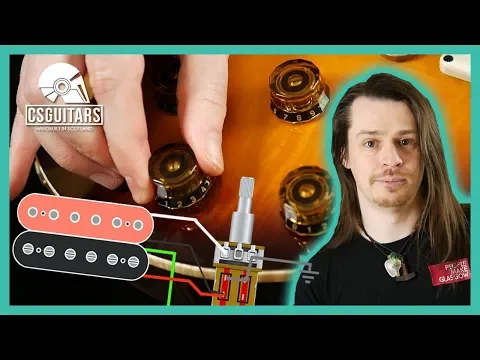
Coil Tapping: The Winding Shortcut
Coil tapping is a more nuanced, albeit less common, modification. Unlike splitting, which turns a two-part pickup into a one-part pickup, tapping accesses the physical winding of a single coil.
How it works:
Think of a pickup coil as a spool of copper wire. A "tapped" pickup has an extra wire attached to that spool somewhere before the end of the winding—often right at the halfway point.
When you engage the tap switch, you bypass the remaining turns of wire, sending the signal out from that "tap" point instead of the full length of the coil.
The Sonic Result:
Because there is less wire in the signal path, the output drops and the pickup's resonant peak shifts. You lose some bass and mids, leaving you with a "sparklier," more vintage-voiced, lower-output tone. Crucially, if you tap both coils of a humbucker, you can technically retain the hum-canceling benefit, though it won't sound like a true single-coil.
- Best for: Reducing output to get a "vintage" vibe from a modern, high-output pickup without completely losing the character of the humbucker.
The "Marketing" Confusion
Here is where things get messy. Major guitar manufacturers frequently use the term "coil tap" in their marketing materials when, in reality, they are offering a "coil split."
Why? Because "tap" sounds technical and impressive, and manufacturers often assume the average player won't care about the difference between shunting a coil to ground and tapping into a winding.
If you own a guitar that claims to have "coil tapping" but you hear hum when you engage the switch, congratulations—you have a coil-split humbucker.
Summary Table
| Feature | Coil Split | Coil Tap |
| Pickup Type | Humbuckers only | Single coils or Humbuckers |
| Mechanical Action | Silences one entire coil | Bypasses part of the winding |
| Sound | Single-coil "quack"/articulation | Lower output, vintage "sparkle" |
| Noise Profile | Reintroduces hum | Keeps hum-canceling (if on HB) |
| Marketing Reality | Often mislabelled as "Coil Tap" | Rarely actually implemented |
Which is better?
Neither is inherently better; it depends on your utility.
If you want your humbucker-equipped guitar to moonlight as a Strat or Telecaster, coil splitting is the gold standard. It gives you the distinct, glassy, and noisy single-coil character that defined decades of music.
If you find your pickups are simply too hot and you want a way to tame them—preserving that "vintage" PAF-style dynamic without drastically changing the fundamental character of the pickup—coil tapping is the more refined, surgical choice.
Next time you’re checking the specs on a new guitar, ignore the label and trust your ears. If it’s a switch that gets you into single-coil territory, it’s almost certainly a split. If it feels like turning down the volume and gain simultaneously, you might just be experiencing the rare beauty of a true coil tap.
What is coil splitting on a guitar?
Coil splitting is a switch that silences one of the two coils in a humbucker pickup, leaving a single active coil. This produces a single-coil-like "quack" or articulate tone but reintroduces the 50/60-cycle hum that humbuckers normally eliminate.
What is coil tapping on a guitar?
Coil tapping bypasses part of a pickup coil's winding by connecting to a tap point partway along the wire, typically at the halfway point. This reduces output and shifts the resonant peak, creating a lower-output, sparkling vintage tone while preserving hum-canceling if used on both coils of a humbucker.
Why do guitar makers call coil splits 'coil taps'?
Manufacturers often use "coil tap" in marketing because it sounds more technical and impressive. Most players won't notice or care about the difference, and the term helps manufacturers appear innovative without explaining the actual wiring modification.
Which mod should I choose for my guitar?
Choose coil splitting if you want true single-coil character and articulation from your humbucker. Choose coil tapping if you want to reduce a pickup's output and add vintage sparkle while preserving the core character. Coil splitting is far more common in modern guitars.
Keep browsing

Get this stuff first.
Leaks, deals and reviews in your inbox, once a week. No spam, just gear.