Fender CEO Admits Mistakes Over Stratocaster Legal Threats
Fender CEO Bud Cole admits the company's aggressive Stratocaster legal campaign got out of hand, shifting focus to large manufacturers

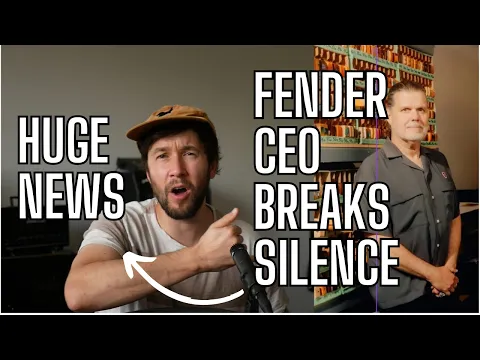
In his first public interview since a wave of controversy hit the guitar community, Fender CEO Bud Cole has admitted that the company’s aggressive legal campaign over the iconic Stratocaster body shape got out of hand. Speaking to Bloomberg Business, Cole acknowledged that the brand could have handled the situation much better.
The legal crackdown—which involved issuing cease-and-desist letters to roughly 60 guitar builders, ranging from boutique workshops to massive global brands—sent immediate shockwaves through the music industry earlier this year.
Fender CEO Admits Legal Process Over Stratocaster Got Ahead of Them
Back in May, Fender insisted its goal was to protect its legendary heritage while fostering a vibrant future for guitar makers.
However, enforcing a German court judgment over the Strat body shape triggered widespread negative publicity and a fierce industry backlash.

Reflecting on the fallout, Cole offered a candid admission:
“There’s been a lot of introspection about this. It’s clear to me that this got ahead of us—the legal process got ahead of us—and that we could have done this better.”
While Cole maintained that the original intent was simply to initiate conversations with companies mimicking the Stratocaster design to "begin to design something that is not a direct copy," he conceded that hindsight points to more effective methods.

Shifting Focus: Big Brands vs. Boutique Builders
Despite the public relations storm, Fender is pressing forward with its strategy—though with a notable pivot regarding its targets.
- The Numbers: Out of the roughly 60 companies flagged, 32 builders are currently working with Fender on draft agreements, with 18 agreements already signed.
- The New Target Audience: Responding to heavy criticism from small shops—most notably Californian boutique builder LsL Instruments—Cole insisted that Fender has changed its immediate focus.
- The Quote: "We are very, very focused solely on large manufacturers now. We are not focused at all now on boutique builders."
Despite this assurance, the damage to smaller brands may already be done. LsL Instruments, which hired veteran industry lawyer Ron Bienstock, has received no clear indication that it is off the hook.
To cover escalating legal fees, LsL has been forced to launch major online fundraisers, including a recent guitar sale aiming to raise $75,000.

Inside the Fallout: Defining the Strat and the Pivot Away From Small Builders
Defending the Crackdown & The "Slippery" Strat
Cole defended the legal campaign by pointing to how modern global manufacturing has accelerated the duplication of classic designs.
“They’re simply copying designs, and that does not help our industry,” Cole said, adding, “We all start out with the same piece of wood. There are unlimited ways to design a guitar with that piece of wood.”
However, defining what legally makes a Stratocaster a Stratocaster remains remarkably elusive. Rather than offering precise measurements, Cole relied on general recognition—drawing comparisons to the famous legal standard for obscenity: “I know it when I see it.”
A Runaway Legal Train and Shifting Targets
When pressed on who ultimately greenlit the aggressive campaign, Cole deflected responsibility toward the mechanics of the legal system itself, noting,
“Once that legal process got going, it got going.”
When asked directly if parent company Servco approved it, he stated, “We led that. That was Fender, the company.”
Despite the collateral damage, Cole doubled down on a major strategic pivot, explicitly distancing the company from small shops:
“We are very, very focused solely on large manufacturers now. We are not focused at all now on boutique builders.”
He maintained that the original letters sent to builders like LsL Instruments were only meant “to begin conversations” about avoiding direct copies, conceding that “in hindsight, there was probably a better way to do that.”
Dealer Backlash vs. Market Reality
The fallout has left its mark on brick-and-mortar storefronts. At Wild West Guitars in Pasadena, California, sales manager Leroy Braxton noted that the public relations disaster has alienated some core fans, summarizing the prevailing sentiment from customers:
“No one likes a bully.”
While some frustrated players walked out to buy alternatives like the PRS Silver Sky, broader market data points to a "flash of protest, not an exodus," with flagship models like the Fender American Professional II Stratocaster holding steady.

The Heavy Toll on Boutique Workshops
For small builders left in the dark, the impact has been structural. LsL Instruments never received direct clarification from Fender, forcing them to proactively alter their business model to avoid severe financial penalties—which carried clauses demanding steep fees for every traditional S-style guitar produced globally.
To adapt, LsL halted standard European shipments of its flagship Saticoy model and heavily redesigned it into a hybrid modern shape. As LsL director of business development Johny Miller explained,
“We needed a replacement.”
Fender reports that 18 out of 32 targeted builders have signed agreements to alter their designs, but boutique brands like LsL are still left guessing where Fender's elusive line is drawn.
Industry Resistance to Fender's Stratocaster Legal Campaign and What's Next
Fender’s legal campaign has not gone uncontested. German retail giant Thomann—which reportedly sells around 10,000 Fender Stratocasters annually—launched a countersuit against Fender to protect market diversity and competition. Other major players like Yamaha, PRS, and Schecter Guitar Research were reportedly caught in the sweep as well.
Even with major pushback, Cole remains adamant that Fender's objective is strictly to encourage innovation and differentiation rather than stifle competition.
"We all start out with the same piece of wood," Cole noted. "There are unlimited ways to design a guitar with that piece of wood."
For the full, in-depth feature, readers can check out the latest report on Bloomberg Business.
Did Fender admit its Stratocaster legal campaign was a mistake?
CEO Bud Cole said "the legal process got ahead of us—and that we could have done this better," acknowledging introspection about the campaign. However, he maintained the original intent was to encourage design differentiation, not stifle competition.
How many guitar makers did Fender target with cease-and-desist letters?
Fender issued cease-and-desist letters to roughly 60 guitar builders. Of those, 32 are currently negotiating draft agreements with Fender, and 18 have already signed agreements.
Is Fender still targeting boutique guitar builders?
CEO Cole stated Fender is "very, very focused solely on large manufacturers now" and "not focused at all now on boutique builders." However, boutique makers like LSL Instruments report receiving no clear indication they are off the hook.
Why did LSL Instruments launch a fundraiser?
LSL Instruments hired veteran lawyer Ron Bienstock to fight Fender's legal threat and launched online fundraisers, including a guitar sale aiming to raise $75,000 to cover escalating legal fees.
Keep browsing

Get this stuff first.
Leaks, deals and reviews in your inbox, once a week. No spam, just gear.