Gamechanger Audio Noise Pedal: 31 Engines of Pure Sonic Chaos
Gamechanger Audio's Noise Pedal is a true-stereo effects unit with 31 broadband noise engines, spectral processing, and IR gesture control for $299.

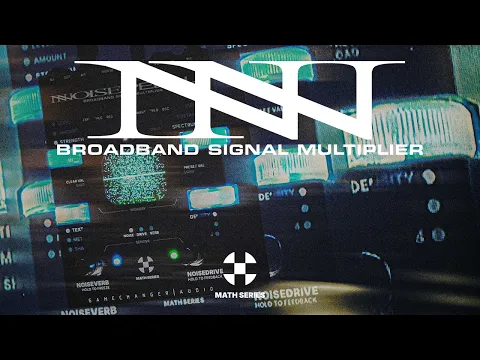
Gamechanger Audio has announced the Noise Pedal, a true-stereo effects unit and standalone synthesizer described by the company as a "Broadband Signal Multiplier." Developed by the Latvian manufacturer's Math Series team, the pedal treats noise not as unwanted hiss to be gated out, but as the raw acoustic foundation for distortion, spectral synthesis, and textured reverberation.
Rather than running standard clipping circuits or conventional algorithmic delays, the Noise Pedal routes an internal broadband noise generator through dedicated shaping controls, then cross-pollinates that noise with your incoming instrument signal across two independent effect engines: NOISEDRIVE and NOISEVERB.
31 Broadband Noise Engines and Pre-Effect Shaping
At the front of the Noise Pedal's signal chain sits a digital noise core loaded with 31 distinct engines. Starting from pure white noise, players can dial through 30 custom broadband sources spanning harsh digital glitches, electrical interference, and crackling static to organic environmental textures like wind, thunder, and fire.
Three global shaping controls sculpt this raw noise source before it hits the downstream effects:
- CHAOS: Governs the internal stability of the active engine, shifting from steady textures to erratic, unpredictable behavior.
- STRENGTH: Controls the overall intensity of the generated noise signal.
- SPECTRUM: Adjusts the frequency balance of the broadband source.
Because both effect sections derive their character directly from this generator, altering the active engine or tweaking CHAOS, STRENGTH, and SPECTRUM fundamentally transforms how the drive and reverb respond to incoming audio. When used without an instrument plugged in, the unit also operates as a standalone noise generator, and connecting MIDI turns the engine into a playable paraphonic noise synthesizer.

NOISEDRIVE: 60 Ways to Cross-Pollinate Signal and Noise
Controlled via the green DRIVE page, NOISEDRIVE merges your instrument's audio with the shaped noise source using 60 multiplication methods divided evenly across three distinct processing families:
- WAVE (Time-Domain Processing): Multiplies your input waveform directly against the noise source using amplitude modulation (AM), ring modulation, wavefolding, and waveshaping.
- FREQ (Frequency-Domain Processing): Deconstructs both your instrument and the noise source into frequency bands before recombining them via Fast Fourier Transform (FFT), spectral modulation, vocoding, formant shifting, and timbral shaping.
- OSC (Pitch-Tracking Synthesis): Converts the active noise engine into a pitch-tracking oscillator that follows your playing dynamics and notes using linear-feedback shift registers (LFSR) and noise oscillators.
Four bipolar encoders shape the DRIVE section: METHOD selects among the 20 variations inside each family; AMOUNT blends drive onto your dry signal in its positive range or completely replaces your instrument with pure noise in its negative range; SUSTAIN stretches notes into long drones clockwise or clamps down into snappy, percussive bursts counter-clockwise; and TIMBRE tilts the output from dark to bright. Holding down the dedicated NOISEDRIVE footswitch engages FEEDBACK, unleashing an immediate, self-oscillating wall of noise.

NOISEVERB: Reverberation Built From Pure Noise
The blue VERB page houses NOISEVERB, an independent stereo reverberation engine that uses the shaped noise source as its spatial medium. It offers three core processing types, each featuring standard and alternate diffusion modes for six reverb algorithms in total:
- FDN (Feedback Delay Network): Blends the incoming signal with the noise source and diffuses the combined texture over time.
- SPEC / BAND (Spectral Noise Reverb): Imprints your instrument's multiband frequency spectrum onto the noise source and feeds it into the reverb tank, producing tails generated entirely out of shaped noise.
- RES (Resonant Swarm): Extracts resonant peaks from both your playing and the noise generator to create dense, phasey swarms of tuned resonance.
Four bipolar encoders govern the reverb's behavior. LEVEL routes your dry instrument into the reverb in its positive range or feeds the post-DRIVE signal in its negative range—a routing path that remains active even when NOISEDRIVE is bypassed.
SIZE spans tight rooms to endless ambient washes while toggling the alternate diffusion mode in its negative range. SHAPE introduces either dynamic DUCKING (lowering reverb volume as new notes hit) or rhythmic PRE-DELAY, while the fourth encoder sweeps the tail from thin, sparse reflections to thick, saturated density. Holding the NOISEVERB footswitch engages FREEZE to sustain the active reverb cloud indefinitely.
Hands-Free IR Gesture Control and Connectivity
To keep real-time manipulation accessible on stage or at a studio desk, Gamechanger Audio built an infrared (IR) optical proximity sensor directly into the chassis. Players can assign the sensor to any combination of knobs across all three parameter pages—with each parameter mapped to sweep in either direction—allowing a single wave of a hand or foot to morph the noise engine, alter drive multiplication, and open up reverb tails simultaneously. Pressing both footswitches together toggles the IR sensor on or off.
| Feature | Specification |
| Audio Architecture | True stereo throughout; independent or series routing |
| Noise Engines | 31 total (White Noise plus 30 custom broadband engines) |
| NOISEDRIVE | 3 families (WAVE, FREQ, OSC), 60 multiplication methods, hold-for-FEEDBACK |
| NOISEVERB | 3 types (FDN, SPEC/BAND, RES), 6 diffusion algorithms, hold-for-FREEZE |
| Gesture Control | Assignable IR optical proximity sensor (toggleable via dual-footswitch press) |
| Memory & MIDI | 128 onboard preset slots; 3.5 mm TRS (Type-B) and USB-C MIDI (PC/CC) |
| Standalone Mode | Operates without input signal; playable as a paraphonic noise synth via MIDI |
Pricing and Pre-Order Availability
The Gamechanger Audio Noise Pedal is available for pre-order directly through the manufacturer's website at a limited-time price of $299 / €299. While the initial batch of signed and numbered Math Series team units closed on November 15, the standard pre-order window remains open until midnight CET on November 23, 2026, with customer shipments expected to begin in February 2027.
- +31 unique broadband noise engines spanning digital to organic textures
- +60 multiplication methods across spectral, time-domain, and pitch-tracking synthesis
- +IR gesture control for hands-free real-time parameter morphing
- +True-stereo architecture with independent effect sections
- +Operates standalone or as MIDI-playable paraphonic synthesizer
- +Freeze function for sustaining reverb clouds indefinitely
What are the 31 engines in the Gamechanger Noise Pedal?
Starting from pure white noise, the pedal includes 30 custom broadband sources spanning harsh digital glitches, electrical interference, and crackling static to organic textures like wind, thunder, and fire. Each engine feeds into the NOISEDRIVE and NOISEVERB sections.
Can the Gamechanger Noise Pedal work without a guitar plugged in?
Yes. Without an instrument input, the unit operates as a standalone noise generator. Connecting MIDI turns it into a playable paraphonic noise synthesizer controlled by pitch-tracking synthesis oscillators.
How does the IR gesture control work?
An infrared optical proximity sensor lets you assign any knob across the pedal's three pages to respond to hand or foot movement. Each parameter can sweep in either direction via a single gesture. Toggle it on or off by pressing both footswitches together.
Keep browsing

Get this stuff first.
Leaks, deals and reviews in your inbox, once a week. No spam, just gear.