Beam Splitter V2: OBNE Upgrades Its Triple Tracker Distortion/Delay
OBNE Beam Splitter V2 delivers triple-tracked distortion with MIDI, presets, and revoiced drives. Full routing and spatial delay effects.

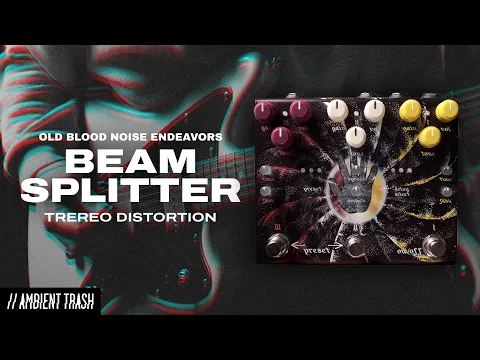
Old Blood Noise Endeavors (OBNE) has officially lifted the curtain on the Beam Splitter V2, bringing massive sonic upgrades, deep preset management, full MIDI integration, and advanced routing capabilities to their celebrated automatic triple-tracker distortion/delay pedal.
Beam Splitter V2: Expanding the Art of Big Sound
Building upon the cult-classic foundation of the original stompbox, the Beam Splitter V2 is designed to solve a timeless guitar recording dilemma: how to take a single mono input and achieve the massive, wall-of-sound depth of a guitar tracked multiple times.
By splitting a single dry signal into three distinct parallel paths—each with its own overdrive character, volume, tone, and independent time-based delays—the V2 allows players to generate rich harmonic washes, dynamic compression, and spatial expansiveness, live on stage or in the studio.
This processor gives you full control over your tone and space. Each drive section features Gain, Volume, and Tone knobs for easy adjustment of distortion, loudness, and brightness.
For delay, you can set the timing up to 211 milliseconds and control the decay using Time and Feedback.
You can also make the delays sound more natural and chorus-like with the Deviate button, widen the stereo sound using Spread, and choose which drive sections use the delay with Delay Select.

What’s New in Version 2?
While the core concept remains rooted in massive multi-tracking emulation, Old Blood Noise Endeavors has heavily upgraded the platform to meet modern rig demands:
Full MIDI Control: Complete command over all parameters via MIDI.
Onboard and Expanded Presets: Save up to 3 presets directly on the pedal, or expand up to 127 via MIDI.
Upgraded Routing Flexibility: Supports Mono, Mono-to-Stereo, and OBNE's proprietary 'Trereo' system via TRS or TS connections, alongside internal stereo input collapsing.
Enhanced Drive 3 Circuit: The transistor overdrive has been completely revoiced to offer a wider, more dynamically reactive range with fuzz-like characteristics.
Lower Noise Floor: Clean component refinements ensure pristine operation even at high-gain settings.
Expanded Control Layout: Added expression pedal control over all main knobs, plus flexible 3-footswitch configuration for individual drive switching or preset cycling.
Under the Hood: The Three Drive Circuits
The heart of the Beam Splitter V2 lies in its three parallel drive sections, meticulously voiced to blend seamlessly together:
- Drive 1 (Hard-Clipping Distortion): The heaviest and most compressed option. As the gain increases, low frequencies gently round off, while mids and highs saturate, producing a fierce core distortion sound.
- Drive 2 (Soft/Hard Clipping Overdrive): The lightest and brightest voice. At minimum gain, it acts as an almost clean boost; turned up, it delivers a punchy medium overdrive that highlights mid and high frequencies.
- Drive 3 (Revoiced Transistor Overdrive): The most dynamically reactive circuit of the trio. Delivering fuzz-like textures, its massive gain range responds intricately to pick attack.

Beam Splitter V2 Spatial Magic: Delays and Spread
Where the Beam Splitter V2 truly sets itself apart from traditional distortion pedals is its dual, independent delay section. Users can route specific drives through the left and right delays using a dedicated select switch.
Featuring Time and Feedback controls, the pedal can generate everything from comb-filtering and slap-back echoes to lush, ambient textures. Furthermore, the signature Deviate control introduces randomized variations in delay time.
Emulating the slight human inaccuracies of recording multiple takes, this function produces organic chorusing, flanging, or broken vibrato textures. When combined with the Spread control, players can dial in a stereo field as narrow or as wide as desired.
Pricing and Availability
Handcrafted in the USA using soft-touch relay switching (True Bypass or Trails modes), the Old Blood Noise Endeavors Beam Splitter V2 is available now with an MSRP of $379/£369.
For more information, audio demos, and dealer listings, visit the official Old Blood Noise Endeavors website.


- +Three distinct, complementary drive circuits with wide tonal range
- +Dual independent delay section with Deviate randomization for organic textures
- +Full MIDI integration with extensive preset management
- +Stereo routing flexibility via proprietary Trereo system
- +Expression pedal control over all main knobs
- +Clean, refined component design for low noise floor
- −Premium price point at £369 may limit budget-conscious buyers
- −Steep learning curve due to complex routing and three-path architecture
What does the Beam Splitter V2 do?
It splits a single dry guitar signal into three distinct parallel overdrive paths, each with independent volume, tone, and delays. This emulates the massive sound of a guitar tracked multiple times in studio, creating rich harmonic washes and spatial depth for live and studio use.
What are the three drive circuits in the Beam Splitter V2?
Drive 1 is a hard-clipping distortion with compressed low-end; Drive 2 is a soft/hard overdrive that ranges from clean boost to punchy medium tones; Drive 3 is a revoiced transistor circuit offering fuzz-like, dynamically reactive textures across a massive gain range.
Can I use the Beam Splitter V2 with MIDI and presets?
Yes. The V2 supports full MIDI control of all parameters, stores up to 3 presets onboard, and expands to 127 presets via MIDI. Expression pedal control is available for all main knobs, and a flexible 3-footswitch configuration enables individual drive switching or preset cycling.
What is the Deviate control?
Deviate introduces randomized variations in delay time to emulate the subtle human inaccuracies of recording multiple takes, producing organic chorusing, flanging, or broken vibrato textures that blend seamlessly with the Spread stereo field control.
Keep browsing

Get this stuff first.
Leaks, deals and reviews in your inbox, once a week. No spam, just gear.