The End of Brand Loyalty: How $500 Import Guitars Are Outplaying $3,000 American Classics
How Chinese automation and global capital are eroding brand loyalty in guitars, allowing $500 imports to match $3,000 American classics.

Around 2012, an unannounced transition permanently altered the global musical instrument industry. In China's Guangdong province—specifically within manufacturing clusters in Zhongshan and Weifang—industrial facilities initiated a sweeping conversion to high-precision, computer-numerical-control (CNC) automated production.
By importing 5-axis machinery from German and Taiwanese suppliers and implementing multi-stage quality-assurance pipelines, these operations systematically closed the historical quality gap that once insulated legacy Western brands from budget overseas competition.
Today, heritage manufacturers face an unprecedented economic reality. High-precision automation, global supply chain integration, and shifting consumer demographics have redefined how electric guitars are designed, manufactured, evaluated, and priced.

The Historical Arc of Offshore Manufacturing
Overseas instrument manufacturing has evolved through four distinct waves over the past half-century:
- 1. The Japanese Wave (1970s): Japanese manufacturers like Tokai, Greco, and Ibanez began building instruments that rivaled American builds. This surge triggered the famous "lawsuit era," as American brands mounted legal challenges to protect the patented shapes of their bodies and headstocks. As Japan’s domestic economy matured and labor costs rose, Japanese builders moved upmarket, leaving lower price tiers behind.
- 2. The Korean Wave (1980s–1990s): Operations like Cort and Samick expanded to fill the mid-tier vacuum, establishing high-volume OEM contracts for brands like Epiphone, Fender (Squier), and Ibanez.
- 3. The Indonesian Wave (2000s): Production shifted further into Southeast Asia, building modern mega-facilities (such as PT Cort) that balanced low labor overhead with increasing mechanization.
- 4. The Chinese Industrial Scale (2010s–Present): Unlike previous migrations, China’s industrial ecosystem did not simply rely on cheap manual labor. Industrial operations backed by massive private capital compressed decades of manufacturing evolution into a single five-year window, deploying automated machinery on an unprecedented scale.

The Mechanics of Modern Precision vs. Hand Assembly
CNC Manufacturing Eliminated Entry-Level Quality Problems
Historically, entry-level import guitars suffered from systemic quality control failures: unlevel frets, uneven nut slots, jagged fret ends, and loose neck-to-body joints that deadened acoustic resonance. The widespread adoption of multi-axis CNC routers eliminated these baseline failure modes.
Modern automated cutters achieve machining tolerances of ±0.05 mm or tighter—a level of precision that is impossible to maintain consistently across a manual assembly line.

Comparative Brand Case Studies
- Eastman Guitars (Beijing, China): Operating out of workshop-style facilities in Beijing, Eastman produces hand-carved archtops and solid-body instruments ranging from $1,200 to over $4,000. Utilizing traditional nitrocellulose lacquers and premium tonewoods alongside modern machining, Eastman now competes directly on touring stages with Gibson’s Custom Shop and Paul Reed Smith (PRS) Core lines.
- Sire Guitars (Indonesia & China): Partnering with jazz legend Larry Carlton, Sire introduced features traditionally restricted to $2,000+ custom instruments—such as rolled fretboard edges, roasted maple necks, and custom-voiced active preamps—into guitars priced between $400 and $800.
- Harley Benton (Thomann OEM): Serving as the house brand for European retail giant Thomann, Harley Benton utilizes high-volume Chinese OEM production to deliver spec-heavy instruments (e.g., stainless steel frets, roasted maple necks, and brand-name Roswell pickups) for under $250—directly challenging $800 mid-tier offerings from domestic brands.

The Tonewood Paradox: Regulation and Signal Chain Reality
Legal Restrictions on Exotic Tonewoods Changed the Industry
A central marketing pillar for premium American instruments has historically been the superiority of aged, domestic, or exotic tonewoods. However, legal regulations and scientific testing have challenged this narrative:
CITES Restrictions and the Lacey Act
In 2003, Bigleaf Mahogany (Swietenia macrophylla) was added to CITES Appendix II, followed in 2017 by the entire Dalbergia genus (encompassing virtually all commercial rosewood).
These global trade restrictions created immense logistical hurdles for Western builders. High-profile U.S. federal raids on Gibson facilities under the Lacey Act in 2009 and 2011—resulting in significant financial settlements and the forfeiture of inventory—highlighted how precarious traditional tonewood supply chains had become. In response, the entire industry was forced to adopt alternative fingerboard materials like Pau Ferro, Laurel, and Richlite.
Acoustic Reality vs. Pickup Signals
Multiple university research projects and double-blind listening tests have evaluated whether players can reliably identify tonewood species in solid-body electric guitars.
Once a string's vibration is translated through magnetic pickups, tone potentiometers, instrument cables, overdrive circuits, and guitar speaker cabinets, human ears fail to distinguish between a $3,000 grade-A Honduran Mahogany body and a $300 basswood or poplar equivalent at statistically meaningful rates.
Overseas Factories Do Not Need Rare Woods for Great Sound
Overseas factories do not need to source rare, highly figured, exhibition-grade woods to produce an instrument that sounds identical in a live mix or a studio recording.

The Structural Cost Disparity
The primary vulnerability for legacy Western manufacturers is the deep structural gap in unit-level labor and overhead costs.
| Manufacturing Metric | High-Precision Overseas OEM | Traditional US Heritage Factory |
| Primary Tooling | Integrated 5-axis CNC & automated fret dressers | Hybrid CNC with extensive manual bench assembly |
| Est. Unburdened Unit Cost | $30 – $70 (off the line) | $400 – $600 (off the line) |
| Key Hardware Specs | Stainless steel frets, locking tuners, bone nuts | Nickel frets, vintage-style tuners, synthetic/bone nuts |
| Retained Margin Moat | High-volume efficiency & low labor rates | Brand legacy, heritage prestige, & domestic labor |
| Target Retail Tier | $200 – $1,200 | $1,500 – $5,000+ |
Even after accounting for ocean freight, international logistics, and 2018-era tariff regimes, overseas factories retain a cost-structure advantage that American facilities cannot overcome without fundamentally altering domestic wage scales.
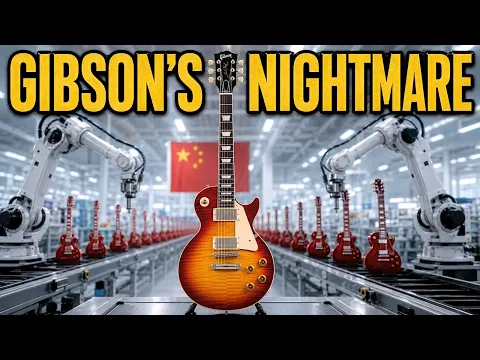
Brand Moats, Bankruptcy, and Digital Transparency
For decades, legacy American brands protected their high margins behind a powerful brand moat. However, three market forces have eroded that protection:
- Corporate Insolvency: Gibson’s 2018 Chapter 11 bankruptcy filing—disclosing roughly $500 million in debt—exposed corporate vulnerabilities and disrupted the perception of absolute market dominance.
- The Death of Gatekept Media: In the 1990s, guitar evaluation was driven by print magazines reliant on manufacturer ad dollars. Today, YouTube channels perform direct A/B audio shootouts, disassembly reviews, and micrometer measurements. When a creator demonstrates that a $400 import guitar performs on par with a $3,000 domestic flagship, the brand premium loses its persuasive force.
- Demographic Realities: Younger players entering the market over the last decade formed their initial playing habits on Sire, Squier Classic Vibe, or Harley Benton instruments. Free from generational nostalgia for 1950s American manufacturing, these players evaluate gear based strictly on playability, feature density, and price.
Strategic Crossroads: Knowledge Transfer and Global Capital
American Manufacturers Created Their Own Competition
The paradox of the current market is that legacy American companies actively engineered the very ecosystem that now threatens them.
The OEM Sub-Brand Pipeline
To capture budget market share, major Western manufacturers established contract relationships with Chinese factories to build sub-brands like Epiphone and Squier. In doing so, Western engineers provided detailed CAD schematics, trained overseas technicians, established strict quality-control protocols, and built local component supply chains.
Once those factories mastered tolerances and finishing techniques, that institutional knowledge spread laterally throughout the regional industrial cluster.
Cross-Border Capital Integration
Overseas manufacturing capital is no longer limited to contract building—it is purchasing heritage brands outright.
In January 2025, HongShan Capital Group (a major private equity firm whose portfolio includes technology giants such as ByteDance and Alibaba) acquired a majority stake in the Marshall Group in a $1.1 billion transaction.
This shift signals a broader trend in which global investment firms acquire iconic Western heritage names while consolidating manufacturing in highly automated, low-cost supply chains.

Market Outlook
The guitar market is bifurcating into two distinct operational models:
- The High-End Provenance Model ($3,000+): Custom Shop reissues, limited artisan runs, and boutique builds remain viable. Buyers in this space are not purchasing raw utility; they are paying for historic accuracy, nitrocellulose finishing, domestic craftsmanship, and brand prestige.
- The High-Utility Production Model ($300–$1,500): Standard mass-production assembly lines face intense long-term pressure. As overseas automated manufacturing continues to elevate baseline playability, the justification for paying a 400% premium for a standard production-line American instrument becomes increasingly difficult to sustain.

Looking ahead, the traditional distinction between "budget import" and "professional instrument" will disappear entirely.
As automated manufacturing continues to refine hardware tolerances and younger players evaluate gear strictly by playability rather than brand pedigree, heritage manufacturers face a clear ultimatum: innovate their cost structures or retreat permanently into the high-margin sanctuary of custom-shop exclusivity.
The brand-name halo effect is fading fast, and in this new era of hyper-efficient production and radical transparency, the ultimate winner is the musician—who no longer needs to spend a small fortune to own a world-class instrument.
Why are Chinese-made guitars now competing with American heritage brands?
Chinese factories deployed integrated 5-axis CNC machinery and automated quality control starting around 2012, compressing decades of manufacturing evolution into five years. This eliminated baseline failure modes like unlevel frets and loose joints. Combined with global supply chain integration and lower labor costs, overseas factories now deliver guitars with ±0.05mm machining tolerances—precision impossible to maintain consistently by hand.
Does tonewood really matter in electric guitars?
Double-blind listening tests show players cannot reliably distinguish solid-body electrics made from $3,000-grade mahogany versus $300 basswood when the signal passes through pickups, cables, and amp circuitry. CITES restrictions on rosewood and mahogany also forced the entire industry toward alternatives like Pau Ferro and Richlite, further negating the tonewood advantage.
What's causing legacy American guitar brands to lose market share?
Three forces converged: Gibson's 2018 bankruptcy exposed corporate fragility; YouTube creators now publish direct A/B shootouts and micrometer measurements that demonstrate feature parity; and younger players evaluate gear on playability and specs rather than brand heritage, free from nostalgia for 1950s manufacturing.
How did Western manufacturers create their own competition?
Major brands like Fender and Gibson outsourced production to Chinese factories under sub-brand deals (Squier, Epiphone), providing CAD schematics, quality protocols, and component supply chains. Once factories mastered these standards, that institutional knowledge spread laterally throughout regional industrial clusters, enabling independent competition.
Keep browsing

Get this stuff first.
Leaks, deals and reviews in your inbox, once a week. No spam, just gear.